



Erin Persley keeps coming back to curiosity when she talks about her work. Not as something aspirational, but as something instinctual; the thing that quietly guides her toward stories she didn’t necessarily know she was looking for.
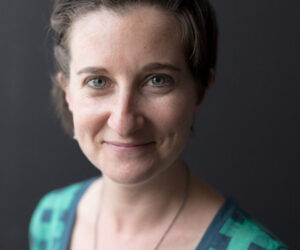

Film Inquiry sat down to speak with the documentary filmmaker about her recent curiosity project, Documentary: Human Shield, which is having its premiere at River Run Film Festival. The documentary provides a lens on the specific volunteer work of escorting women into abortion clinics, and it’s one that’s both riveting and immensely human.
This interview has been edited for clarity.
What made you get into this field and why this subject specifically?
Erin Persley: Essentially, I became a documentary filmmaker because I’m curious. My curiosity always gets me sort of thinking about things like, “Oh, that seems interesting. I wanna learn more.” I think part of what I realized is like I just like to ask a lot of questions. Like, I think when I was a little kid I thought I was nosy, but now I just realized, no, I’m just curious. I wanna know more.
Love that! What changed as you started to uncover more and let that curiosity dig in?
Erin Persley: I live in San Francisco and I thought to myself that I had seen or knew—at least I thought I’d seen every abortion documentary to some degree, and I thought I had known mostly every aspect of reproductive rights. And I think I was in the same boat when I discovered this in 2017. I was like, “Oh, wow, there’s so much more to this than I even thought.”
It came through because of a Huffington Post blog post by reproductive‑rights advocate and clinic escort Lauren Rankin. I reached out to her right away.
What was that conversation like?
Erin Persley: She talked about escorting as psychological warfare, which I was like, “Oh, wow, that just totally had me thinking.” And then she talked about how escorting is not really about abortion, it’s about compassion. Of course you can’t remove what abortion is from escorting, but at the core of it, it’s really just stepping up and supporting other people and finding your own level of empathy and compassion.
I direct messaged her and I was like, “Hey, Lauren, you don’t really know me. I read your article. I would love to like ask you a couple questions. I’m just curious to learn more.” And she was so kind, and she gave me her phone number to a complete stranger.
How did that shift and transform?
Erin Persley: What I learned is that the escorts themselves are really the experts. They live it, and so they have to know it. So I really reached out to them, and those conversations were very informal—on my couch or my chair. I would record some of them or take notes, and they would often say, “Oh, you should reach out to so‑and‑so.”
From there, I started reaching out to other writers who had covered the space—newspaper writers, people who had written books. There’s an anti‑abortion violence book by DS Cohen, so I reached out to him, did a call, and read his book. I also connected with groups like the Feminist Majority’s National Clinic Access Project, which does a lot of research on clinic violence. I spent time looking at statistics through places like the Guttmacher Institute, which led me to groups like the National Abortion Foundation.
A lot of it was word of mouth—one person would recommend three more. I also connected with a few other documentary filmmakers who had worked in this space, not necessarily on escorts, but on different parts of the larger movement. I wanted to understand where their journeys had taken them and what information had been useful.
The escorts are very guarded, so it took a long time to build trust. When one person trusted me, they would recommend me to someone else. Letting them lead part of the journey was more helpful, because they know more and were able to guide me toward the best way forward.
Early on, escorting was described to you as “psychological warfare.” Did that verbiage stick with you as you learned more?
Erin Persley: I don’t think everyone sees it that way. I think it’s really interesting, and that’s the one thing I really learned about talking to so many escorts is they have so many different ways that they process what they do
That idea made sense to me because you almost have to put on a façade where you don’t let these horrible things bother you. You endure it in all types of weather for long periods of time. There’s a mental game happening between protesters and escorts—they’re on opposite sides, maintaining composure, putting up a kind of shield. That’s why psychological warfare felt like an accurate way to describe it.
Most escorts are volunteer programs, and most of them are non-engaging. So, essentially their purpose is to absorb the chaos, almost like a sponge.But to not sort of respond or react.
It also made me think about what happens afterward. You put up this intense exterior; what happens when you go home and have to do something else? How do you separate that intensity from everyday life? Because this is just one small piece of what they do.

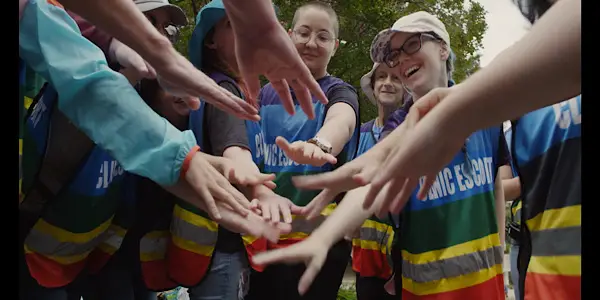
That is a profound point. Why was it important for you to include multiple clinics and locations rather than focusing on just one?
Erin Persley: If I had just focused on one clinic, you would still get a strong sense of what it’s like to be an escort. But I don’t think you would really see how nuanced the experience is. Every clinic setup is different. Rural clinics versus urban clinics have very different challenges. Their relationship to police is very different depending on where you are. And this is happening everywhere. It’s happening in quote‑unquote liberal bubbles and in conservative spaces. That visibility felt important to me.
Erin Persley: I started filming in April of 2018. That was the first day I filmed with the Toledo clinic. Most of the filming happened over several years. I didn’t film in 2020 because of COVID, but I continued through 2021, 2022 and 2023. I also wanted to keep filming after Roe fell, because- just because Roe wasn’t there, it wasn’t that these escorts were going to disappear.
What surprised you the most once you started? How did your perspective change?
Erin Persley: I expected a couple of things going into this. When I was making the film, I didn’t really know where it was going to go, but I knew I didn’t want to make something that just felt like, here’s the shitty world we live in, and we made it this way, so now we’re all going to be depressed. I knew I wanted the film to feel hopeful.
What really inspired me about the escorts was their resilience. They knew Roe was going to fall long before it did. They had been preparing for it for years, and they keep going even though they get hit after hit. That, to me, was the most inspiring part: how resilient they are and how hopeful the work can be. That surprised me a little, because I was pretty deep in a doom‑and‑gloom headspace at the time, with everything going on in the world.
The other thing that really surprised me was how much fun they have. Obviously, the film focuses a lot on the really stressful shifts, but there were so many moments when they were playing music, dancing, eating donuts — just genuinely enjoying being together. Patients were talking with them, and there was so much joy in those spaces. Abortion doesn’t have to be this negative, stigmatized idea. You can feel relief, and you can feel joy, and that’s okay.
I wish I could have included more of that: the dancing, the dance‑offs at the clinic — but it didn’t quite fit. There’s so much footage I didn’t use. And beyond that, the sense of community really stayed with me. They’d have potlucks and Friendsgivings, and I went to those, too. Seeing how deeply connected they were, how they showed up for each other, was incredibly rewarding.
I love to hear that. Given how polarizing the subject remains, what do you hope people take from the film?
Erin Persley: I didn’t intend to make the film thinking it would convince people who are already anti‑abortion or pro‑life. I do think that because our political climate is so divided, there’s a lot more push surrounding the topic. What I would really love is for people who might feel a little uncomfortable with abortion to think about escorting as community care. It’s essentially about stepping up to support your community when someone needs help.
On the most basic human level, that feels very relatable to me. So much of what we’re dealing with right now comes from top‑level government decisions, but at the heart of it, our communities are built and strengthened by people supporting each other. It’s crossing guards helping kids get across the street. It’s all those everyday moments of people just helping out. If there’s anything I hope people take away, it’s a reminder that communities really do support each other—and that this level of compassion exists in all of us.
I’m also realistic that abortion is challenging for a lot of people. I would love to think that every abortion film that comes out helps normalize and destigmatize it, at least a little. The more openly we talk about it, the more it helps. That’s part of why I included personal stories in the film and how being honest about an experience drives you to escort.
But you don’t have to be someone who’s had an abortion to want to support abortion access. That’s why it was important to include someone like Jeremy, to show that men can be involved in this work, too. This isn’t just a women’s issue:it’s a human issue. That gives me hope.
I know there’s still a level of discomfort and squeamishness for some people, and that’s unfortunate. It’s even more complicated now, after the overturning of Roe, where everything is happening at the state level and rights are being eroded little by little. That’s one of the reasons we really pushed to release the film this year.
As much as we should all be voting and staying politically engaged (and I truly believe abortion is on the ballot every time we vote) we also can’t rely on government officials to save us. We need to save ourselves. We need to remind ourselves that communities have to come together. Reproductive rights, human rights, immigrant rights, economic rights—they’re all interconnected. You can’t focus on something like high gas prices and ignore the fact that there are people dealing with truly extreme conditions every day.
That’s so lovely. Thank you so much and congratulations!
We want to thank Erin Persley for taking the time to speak with us.
What emerges through Persley’s reflections is not a singular argument, but a sustained act of attention. Human Shields doesn’t ask viewers to resolve the abortion debate or arrive at consensus. Instead, it asks them to notice the labor that absorbs chaos, the care that operates in public, and the community that forms in moments of strain. It’s a documentary put together with care, empathy and a lot of heart.
It is a documentary that follows several escorts and it shows the day to day of this volunteer position. The film is delivered in a way that’s educational and inspirational. Persley is an expert in this space and utilizes her passion with skill, creating a compelling project on an unseen corner of the system.
Curiosity may have been the entry point, but what remains is presence; a willingness to listen first, and to make visible what has long been standing quietly in plain sight. I saw those workers, and you should too. Human Shield is one that deserves to be seen.
Does content like this matter to you?
Become a Member and support film journalism. Unlock access to all of Film Inquiry`s great articles. Join a community of like-minded readers who are passionate about cinema - get access to our private members Network, give back to independent filmmakers, and more.