



What do women warriors want?
Two similar movies released over the last year or so have come up with somewhat different answers to this question. Both The Lord of the Rings: The War of the Rohirrim (2024) and Red Sonja (2025) focus on the lives and deeds of young women whose skills with a blade are put to the ultimate test in epic battles for the control of imaginary worlds. And both Héra in Rohirrim and Sonja in the movie named for her are supplied with red hair, superb horsewoman skills, and childhood friends who become bitter enemies that they must face in climactic duels.
Perhaps most tellingly, both women warriors began life on the page almost a century ago as obscure characters conjured by writers – J. R. R. Tolkien and Robert Howard, respectively – who are best known for constructing vast fantasy worlds dominated by men. That the twenty-first century legacies of Tolkien and Howard are bound up with movies that focus on afterthought women characters says as much about the complicated and ever-evolving strategies of Hollywood adaptation as it does about the authors’ work.
Daughter of Kings
Héra is the more improbable of the two characters to arrive on screen as the heroine of a high-profile Hollywood production. Technically, she does not even exist as a character in any of Tolkien’s Middle-Earth narratives proper. She appears in one of the appendices that Tolkien added to The Lord of the Rings, his epic trilogy, after its initial publication in the 1950s only as a single reference to the unnamed daughter of Helm, a famous king, who is asked to give her hand in marriage to the son of a rebellious warlord. The film builds out the story of the war that ensues, naming the warlord’s son Wulf and forcing Héra to demonstrate her courage over and over during a prolonged siege through a bitter winter in a mountain fortress that will eventually be named, in memory of her father, Helm’s Deep.
Clearly, Héra serves as a means for Peter Jackson and his filmmaking team, particularly longtime collaborator and Rohirrim producer Philippa Boyens, to appeal to Middle-Earth’s legions of female fans. Héra is a young shieldmaiden of the Rohirrim, a people who are, in Tolkien’s original description, “proud and wilful [sic],” but “true-hearted, generous in thought and deed; bold but not cruel; wise but unlearned, writing no books but singing many songs.” The term shieldmaiden is one of Tolkien’s coinages, and it shows up as well in Jackson’s original film trilogy as both a compliment and a consolation to Éowyn, a brave warrior in her own right, but one of the few speaking parts for women in the Lord of the Rings films.
In this animated follow-up, directed by Kenji Kamiyama, we learn a little more about the history of the order of the shieldmaidens, with the middle-aged Olwyn serving as Héra’s faithful comrade-in-arms and occasional rescuer. This is one of several curious choices made for Héra: as skilled and fearless as she is, she almost never survives any of her many deadly encounters without help, some of it bordering on deus ex machina miracles.

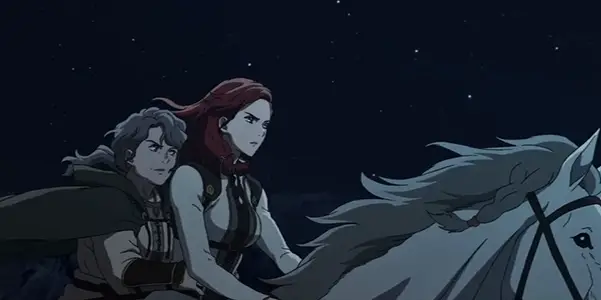
In an early scene, Héra is saved from an enraged Mûmak, one of Tolkien’s giant war-elephants, by an obscure monster who makes a brief appearance early in The Lord of the Rings. A little later, when Héra is surprise-attacked in a stable, it’s her horse who makes sure she lives to ride another day. And late in the film, during the siege, her father shows up just in time to thwart a pair of renegade orcs who have taken her captive. (He then outdoes himself by warding off a snow monster of the mountains with nothing but his bare fists, though Héra does, eventually, help him vanquish that beast.)
Despite her apparent inability to handle such trials on her own, Héra emerges as an appealing figure. She is direct and decisive, riding out unhesitatingly toward danger, especially on behalf of her friends. She is honest and trustworthy and humble in her relationships with other creatures, a friend not just to horses but also to the giant eagles of Middle-Earth, always the sign of a true heart in Tolkien’s stories. And her willingness to at least attempt a peaceful resolution before facing off with Wulf, her old childhood friend and sparring partner, speaks well of her commitment to peace.
For the climactic duel with Wulf, Héra also dons a tattered wedding dress, a clever, ironic reminder of the idea that if she had been willing to submit, conflict might have been avoided, but only temporarily and on unacceptably imbalanced and subservient terms. And while she is given the cute, girlish features, including the wide-set, over-sized eyes, so common in animated heroines, she is provided with a sturdy frame and a sturdy resolve that make her a plausible girl power heroine for young audiences.

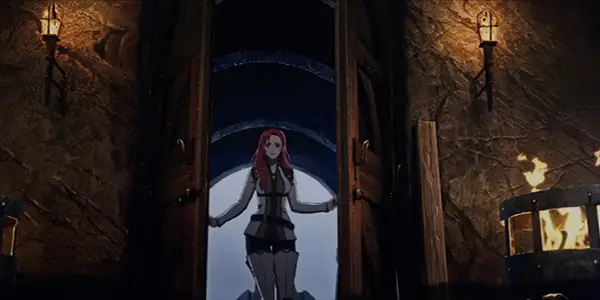
The plot also devises some appealing dramatic scenes for Héra that feature artfully accoutred settings and defiant exchanges with her companions and her foes alike, investing the literal battles with substantive emotional stakes. Héra is easy to root for, her final choice – to maintain her independence at the cost of conventional honors and prestige – easy to cheer for.
She-Devil with a Sword
Such winning elements in the animated movie make the recent screen characterization of Red Sonja all the more disappointing. The movie clearly aims to portray Sonja as a complex, fully-drawn role model of a young woman protagonist, but, unfortunately, with limited success.
The 2025 film is just the latest update of a character who debuted in one of the exoticized adventure tales of Robert Howard in the 1930s. In stark contrast to Tolkien, the Oxford don who literally helped to write the Oxford English Dictionary, Howard was a desperately prolific pulp fiction writer more in the mold of Poe or Jack London, plying Weird Stories and other provocative serials of the day with manuscript after manuscript in hopes that some of them would sell.
In 1934, Howard managed to publish “The Shadow of the Vulture,” a story set in 17th century Ukraine, featuring a swaggering, ferocious Cossack fighter named Red Sonya of Rogatino battling the Sultan in a breathlessly violent vision of the Crusades. Two years later, in 1936, Howard killed himself at the tender age of 30, and his fire-tressed fighter disappeared until the mid-70s, when comics writer Roy Thomas debuted Red Sonja (now with a ‘j’ instead of a ‘y’) for Marvel.
Ironically, Thomas took co-author’s credit for stories that were actually scripted by Hollywood screenwriter Clair Noto, whose name was often misspelled as “Clara Noto” in the masthead. As a result, Thomas is the one who is usually credited with the crucial removal of Sonja from her original Crusade fantasy setting to make her a contemporary counterpart of Howard’s most famous character, Conan, an escaped slave turned barbarian freebooter who roams the author’s fictional Cimmeria in search of adventure, wealth, and, eventually, a realm to rule as king.
With her long, curly red hair, chain mail bikini, and unquenchable appetite for liquor and licentious conquests, Sonja seems a natural for Hollywood and its long-running (not to mention shameless) romance with sword-and-sandal epics. But despite her enduring popularity in comics, Sonja has inspired just two big screen adaptations. The first was released in 1985 and borrowed a cheerily bare-biceped Arnold Schwarzenegger from Dino de Laurentiis’ Conan franchise to star alongside the statuesque Brigitte Nielsen, whose 6’1” frame was made even taller by her vintage early MTV-era do.
The version released this past summer casts the former model and comparatively petite Matilda Lutz as the she-devil with a sword. This Red Sonja feels even more brazenly like a money-making venture than Rohirrim, cobbling together various story elements from other fantasy films and franchises (including Jackson’s Lord of the Rings trilogy and, most obviously, Ridley Scott’s Gladiator) in hopes of crafting a story that will appeal to action fans and pop culture feminists alike.
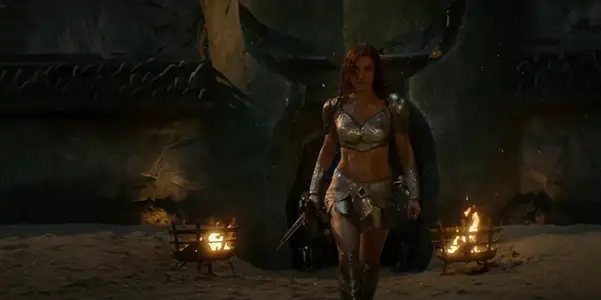
Sadly, the result is a patchy, poorly paced, inconsistently toned movie that leaves Sonja more exposed to critique than even the skimpiest version of her shiny signature attire.
The story theoretically hinges on an ancient magic book that is partially destroyed when Sonja, as a child, survives the sacking of her village and the murder of her family at the hands of invading barbarians. The mystic tome, of course, is actually just broken in two, which means that Draygan, the arch villain of the story (a self-styled champion of science, progress, and animal cruelty) merely needs to restore the text and speak its full magic to rule the world. That the book was formerly used in reverent ceremonies conducted by holy women of Hyrkania, Sonja’s homeland, only enhances the personal stakes for the protagonist, whose allegiance to the vaguely pagan priestesses goes without saying.
(But not without singing. In a bizarre, out-of-the-blue scene set in the dungeon barracks of a gleaming CGI cliffside arena that would make Ridley Scott blush, newly arrived Sonja is so moved by the fatalism of her fellow conscripted gladiators slated to die that she suddenly decides to bestow an a cappella version of a Hyrkanian folk song on them and on bemused viewers alike.)
The piety of this Sonja seems one of several misguided elements of the film. Arguably, the best writer of the Hyrkanian she-devil with a sword is neither Howard nor Roy Thomas, but Gail Simone, a clever mischieve of a scribe who, in many years of writing Sonja comics and, more recently, in a novel called Red Sonja Consumed (2024), excels at finding humor everywhere around the bikini-clad barbarian, usually in scenarios that are, nevertheless, charmingly chock-full of violence and brutal politics for Sonja to navigate.
Simone’s Sonja is smart but no grind, lusty but no one’s plaything (or at least no one’s but her own), and, perhaps most signally, an intuitive enemy of sorcery, wizardry, and bookishness in general. The freest of free spirits, Simone’s Sonja has a clear sense of right and wrong, but no allegiance to any crown or cause more important than her own freedom and enjoyment, which she usually seeks in public houses, where she eagerly and determinedly surfeits all of her bodily appetites, first on the provender and then, as often as not, on her fellow patrons.
Simone is credited as a co-executive producer on Red Sonja, and you can see bits and pieces of her vision of the deadly swordmaster in the situations the film cooks up for her. But those bits and pieces are nearly drowned in overlong speeches, premature revelations, jarring tonal shifts, and unimaginative visuals. Just as unwisely, the script attempts to make Sonja a role model for soft-hearted social causes.

One early scene designed to demonstrate her humanitarian love for animals is set in what could almost be a suburban park with the picnic benches CGI’ed out of the frame. It’s a far cry from the Sonja of Simone’s comics, whose unquenchable thirst for liquor is matched by her voracious appetite for freshly killed animal flesh, gnawed directly from the roasting spit, as often as not.
There’s a summary of this movie that could make it sound plausible, even appealing. A young woman fights for her homeland against an equally young but insufferably vain, cruel princeling who aims to be king. She bands together a small but hearty group of companions, fellow survivors of tyranny and injustice, to fight the impossible but good fight against the dastardly and much more powerful forces of their oppressor.
But the movie that tries to fill in the details of this scenario lurches along unsteadily, like a college student’s desperately AI’ed essay, spitting out bits and pieces of material that might seem, taken piecemeal, like the products of a focused imagination, but which result, cobbled together, only in a mishmash that is much less than the sum of its variegated parts: flighty, superficial, and diffuse to the point of helplessness.
Shielding Hollywood
So what does a woman warrior want? These two films finally offer not just different answers, but answers that require a reframing of the question. What does Hollywood want for its women warrior characters?
The simple answer is, of course, to help carry long-running franchises forward, to draw in audiences that have been appealed to, but not as directly as in male-driven films, by reinforcing predictable, if not clichéd, visions of freedom and self-determination. But of the two, Héra is far more free than Sonja to achieve such independence precisely because she does not have to serve as the vehicle for future money-making ventures, her character a one-off who need not ever appear on screen again to have done her work.
Ironically, it is the animated movie, then, that seems more enduring than the “live-action” Red Sonja, which ends with the promise (or threat) of reuniting her character with Howard’s other barbarian swordmaster, Conan. Like so much else in the movie, this coda serves up another contradiction, Sonja seeking out a man not because she needs one, but because it would (theoretically, at least) increase her box office appeal – further betraying the cynicism that fuels this latest adaptation.
That said, there’s no reason to feel sorry for Sonja, only reason to hope that, someday, her character will get to exercise the fuller independence that Héra enjoys at the end of her story and that Simone, in her comics and novel, accords to her. Until then, Sonja will serve more as a shieldmaiden for Hollywood than for Hyrkania, a pawn in the silver screen profit wars who can only envy her distant Middle-Earth sister.
How do Héra and Red Sonja compare to other women warriors of Hollywood?
Does content like this matter to you?
Become a Member and support film journalism. Unlock access to all of Film Inquiry`s great articles. Join a community of like-minded readers who are passionate about cinema - get access to our private members Network, give back to independent filmmakers, and more.