



Since the original Toy Story premiered back in 1995, Pixar has been one of the dominant animation studios in Hollywood, reliably producing well-made, emotionally intelligent, and technologically innovative films that push the medium of animation a little further every year. We’ve seen toys with emotions, fish with emotions, and emotions with emotions as Pixar has, for 30 years, made one instant classic after another.
But as with any studio whose output is so consistently excellent — blips like Cars 2 notwithstanding — it’s hard to choose the best movie Pixar ever produced. Nearly every film in the company’s catalogue has its merits, and you could make a good argument for almost any one of them. (Again, Cars 2 notwithstanding.) In honor of the premiere of Pixar’s 30th film, Hoppers, we asked the critics and editors here at Film Inquiry to pick what they think is the best Pixar movie.
Toy Story — Lee Jutton

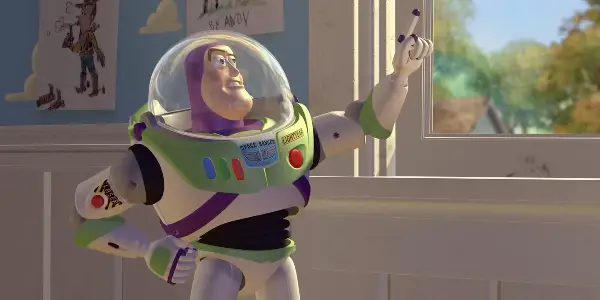
It’s been 30 years since the original Toy Story landed in movie theaters, and while Pixar has produced its fair share of stellar films since then, I can’t help but feel compelled to go back to the beginning when asked to consider which one is best. The first entirely computer-animated feature film centers on the relationship between folksy cowboy doll Woody (Tom Hanks, in an incredibly endearing voice acting performance) and the shiny new spaceman, Buzz Lightyear (Tim Allen, pompous and hilarious), who is on the verge of taking Woody’s place as Andy’s favorite toy. While these rivals eventually become friends, realizing that there is more than enough room in Andy’s heart for both of them, they encounter multiple obstacles along the way, including a cruel bully who tortures and mutilates toys (and who reminded me so much of the neighborhood bullies where I grew up).
I was about 7 years old when Toy Story was released in 1995, and that was the perfect age to be introduced to this magical world where toys come alive behind humans’ backs and have their own drama to deal with. At the same time, one of the things that made Toy Story such a big hit then and such an enduring classic today is that it appeals to audience members of all ages; the humor, music, and voice acting performances can be appreciated by anyone with a pulse. Thirty years (and many sequels) later, Toy Story remains a captivating example of animated storytelling at its very best. –Lee Jutton
Toy Story 2 — Faisal Al-Jadir
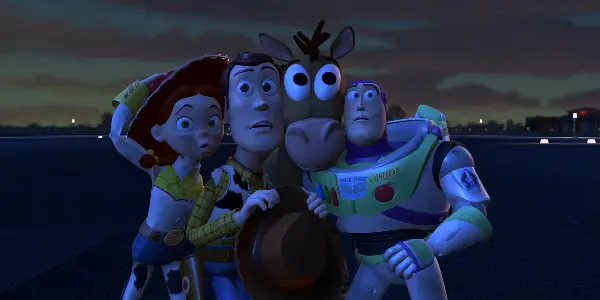
While I could’ve gone with Up (featuring some of Pixar’s finest moments and themes) there’s something poignant about Toy Story 2 that cements its place as my personal favourite Pixar’s film. The Toy Story series is full of beautifully realized desires, dreams and fantasies, with an undercurrent of existential dread and fear. Behind the immense “cosmic threat” that the familiar characters face, there’s a deeply personal loss that some of the newer players continue to hold on to. The latter aspects are handled with grace and maturity, and I feel they were most exquisitely captured in the beautifully animated Toy Story 2.
Throughout the series, the toys always worry about being redundant. Toy Story 2 exhibits both the downside of being forgotten and the promise of eternal companionship. The key to that is in the character of Jessie the Cowgirl (Joan Cusack), a member of “Woody’s Roundup,” a retro children’s Western series. At one point in the film, Jessie has a song which serves as a soliloquy of sorts, lamenting how betrayed she felt when her own owner, Emily, gave her up as a donation to a charity drive.
I could talk about a number of amazing aspects that this film has to offer, but this particular point hits hard. Like in Up (which was ironically more grounded in its themes), this movie suggests that the universe is indifferent to our individual plights; it doesn’t owe us anything.
The beauty of Toy Story 2 is that it lets its audience, children and adults, accept that we are going to face abandonment. We are going to face being unwanted… but it doesn’t mean it’s going to be the end for us. There is a light at the end of the tunnel, illuminating the possibility of newfound happiness. –Faisal Al-Jadir
Monsters, Inc. — Jake Tropila
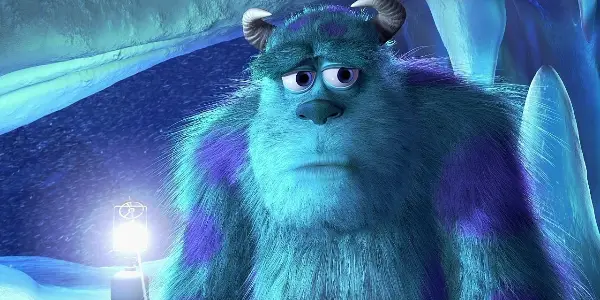
Critical consensus may never reach an agreement as to what Pixar’s best effort is — and there are certainly plenty of worthy contenders — but for this author, Monster’s Inc. remains the perfect confluence of innovation and heart that the company is renowned for. The premise alone is incredibly inspired: What if the closet-dwelling ghouls that go bump in the night were actually esteemed members of a blue-collar workforce, whose purpose is to scare children during their 9-to-5’s to hit a company quota? It’s a brilliant setup, and still only the tip of the iceberg as far as this film’s imagination goes, which follows top scarer Sulley (John Goodman) and best pal/work colleague Mike Wazowski (Billy Crystal), who have everything turned topsy-turvy when human child Boo (Mary Gibbs) inadvertently gets stuck in their world.
Casting has always been one of Pixar’s strongest suits, and Goodman and Crystal are no exception: The former is a wonderfully gruff gentle giant, while the latter’s manic energy easily steals the show (supporting roles contain no slouches, either). Spectacular moments abound, including the thrilling door-hopping climax that feels more exciting than anything that can be found in The Incredibles, and while many will likely claim Up’s prologue to be the most heart-rending sequence in Pixar’s catalogue, I defy anyone to not get choked up during Sulley and Boo’s final encounter. It may have only been the fourth film produced by Pixar, but Monsters, Inc. has tremendous lasting power, and no amount of misguided prequels or sequel series will ever diminish its quality. –Jake Tropila
Finding Nemo — Payton McCarty-Simas

Growing up during what many rightly call the golden age of children’s films — in no small part thanks to Pixar — was wonderful because it meant that, on top of having consistently excellent movies to watch year round, Finding Nemo happened to be the first film I ever saw in a theater. I was 5, I ate an entire medium popcorn by myself, and I was absolutely obsessed. With a list like this, it’s easy to make a case for almost any film in the first two decades of the Pixar lineup to be the best. The thing that I love about Nemo specifically, though, is its bifurcated road trip structure, its rhythms, and the way it carries you through the story like a sea turtle riding the EAC.
This movie is both genre-blending and sweetly grounded in its father-son story, moving from heist to mystery (P. Sherman, 42 Wallaby Way, Sydney) to adventure to comedy and back again. It’s also replete with a particularly iconic cavalcade of instantly quotable side characters (my favorite was always Crush the stoned surfer sea turtle) and wildly surreal in a way that instantly captured my imagination, from the kid-psychedelia of the massive school of cryptographic, direction-giving fish or the evil jellyfish forest, to the POV horrors of a little girl “shaking the bag,” to the strange tragicomedy of Dory’s (Ellen DeGeneres) amnesia, all the way down to the vibrant live sea anemone these clownfish call home. Its characters are complex enough to spark a child’s empathy and curiosity — I spent a lot of time having early, protean thoughts about morality because of both Willem DaFoe’s “I’ve been hurt before” mentor, Gill, and Bruce the fish-addicted shark (Barry Humphries) — while remaining streamlined, comprehensible and classic. Finding Nemo feels like a field trip and a particularly good dream wrapped into one. Just keep swimming! –Payton McCarty-Simas
Ratatouille — Owen Butler
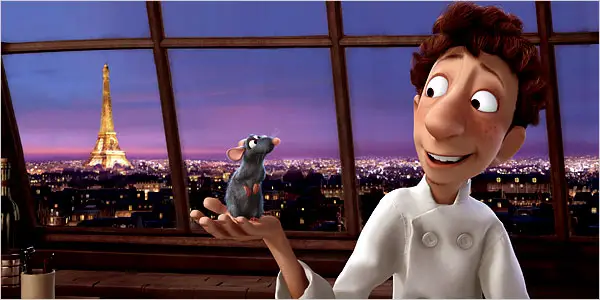
I was only a little less than 5 years old when Brad Bird’s Ratatouille was released into theaters in the summer of 2007, and in the almost two decades since, this story of Remy (Patton Oswalt), a rat with heightened senses of taste and smell who longs to use his aptitude for cooking to become a chef in Paris, still remains very close to my heart.
Bird’s third feature film after The Iron Giant and The Incredibles (two other childhood favorites of mine that also hold up tremendously well), Ratatouille is as emotionally incisive as it is a technical triumph of the animated medium. Bird’s magnificent directorial capabilities are on full display alongside a phenomenal score from Michael Giacchino. Its thoughtful examination of the line between its protagonist’s artistry and his identity, and the fulfillment that arises from his refusal to let that come between him and his passion, is as potent as his culinary creations. To quote the film’s fictional critic Anton Ego (Peter O’Toole), “Not everyone can become a great artist, but a great artist can come from anywhere.” –Owen Butler
WALL•E — Linsey Satterthwaite
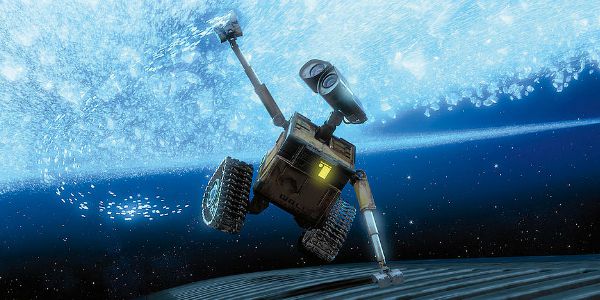
Anyone who knows me, knows that my cinematic weak spot is robots that have an innocent, childlike and humanistic quality. So it would be only fitting that my favourite Pixar film would be WALL•E. But even without the worship of those with cute wires, this film felt like the studio, which had already broken new grounds in animation, reaching new heights with their storytelling.
This is established right at the beginning of WALL•E, with a stunning, nearly wordless first act where we meet our titular hero, a robot who has been tasked with cleaning a waste-covered Earth. Scenes play out with striking and stark visuals as we get to know WALL•E, who is like a cross between Short Circuit and Charlie Chaplin, and we see what his life looks like. This all changes with the arrival of the sleek and sophisticated robot EVE, whom WALL•E falls in love with and which sets in motion a journey to save mankind.
After its bravura beginning, WALL•E then sets into familiar Pixar territory (assortment of characters, moments of peril, a race to save the day, etc.). But the themes that it covers have become more prescient since its release in 2008: the ruin of our planet, the climate crisis, and people’s over reliance on technology and subsequent lack of functioning for themselves.
Alongside its foreboding narrative, the images that are conjured up within the film weave between the beautiful and the brutal. A dance amongst the stars between WALL•E and EVE is dazzlingly romantic and feels like a robot version of Fred Astaire and Ginger Rogers gliding across the universe. While a scene where WALL•E scavenges for replacement parts from a defunct version of himself is horrifyingly heartbreaking.
Pixar have not been afraid to go there with their films but WALL•E felt like a studio reaching for the stars and getting there. A space odyssey that points directly to our decaying planet and the need to hold onto the parts that make us human… and that make a robot too. –Linsey Satterthwaite
Toy Story 3 — Jules Caldeira
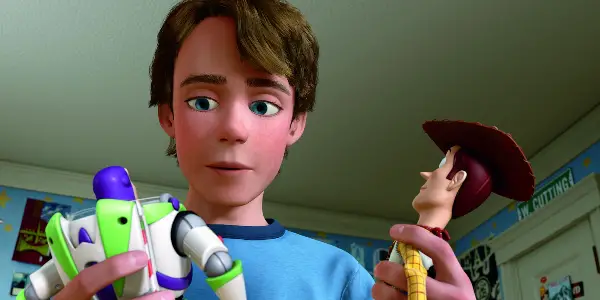
It goes without saying that the original Toy Story is a masterpiece. From its impact on film and animation as the first feature-length, fully computer-animated film to its iconic characters and dialogue, there’s a reason so many sequels have been made, with attractions and even full lands appearing in various Disney parks.
However, as much love as I have for the first and second films, for me the pinnacle of the series has always been Toy Story 3. Of course, this was due not only to the improved animation and storytelling that set it apart from its predecessors, but also the timing of the film’s release. I grew up being exactly the right age for the original, and when the trailer for this film came out revealing that Andy was going to college, I couldn’t help but cry. I cried not only because we were getting to see the adventures of Andy, Woody, and the gang continue, but because I was on the same adventure as Andy; I was preparing to go to college too. This parallel between my life and the lives of the characters I grew up adoring hit hard, and when I finally sat down to watch the film, the laughs and the tears hit even harder.
Toy Story 3 is a testament to how far Pixar had come at the time, and it set the standard for this and other franchises. People who were born a few years too early or late may not feel quite the same, but those of us who were born in that sweet spot will never forget the realization that Andy grew up too, just like us, and you didn’t have to sacrifice your childhood memories, your joy and nostalgia, to do it. Instead, you could share it with the next generation. –Jules Caldeira
Soul — Tej Narayanan
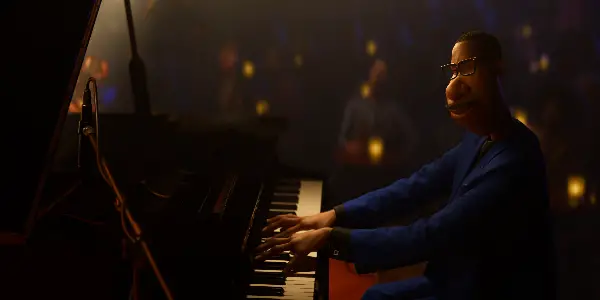
Pixar has made plenty of masterpieces, but Soul stands above them because it captures something most Pixar movies rarely attempt: the texture of simply being alive. Its version of New York feels unusually intimate, lingering on barbershops, cramped rehearsal rooms, subway platforms, and stoops where conversations stretch longer than expected. The neighborhoods feel lived in, rooted in a specific African-American musical community that shapes protagonist Joe’s (Jamie Foxx) worldview. Even before the story drifts into the metaphysical, the movie grounds itself in a world more uncomfortably real than other animated movies attempt.
When the film moves to the afterlife, the contrast becomes part of the storytelling. The cosmic realm is spare and abstract with soft lines, drifting shapes, and quiet moody color schemes. The two visual languages quietly frame the movie’s central tension: the difference between the tidy idea of a life and the messy experience of living one.
The narrative follows that same instinct. What begins as a familiar animated setup (a man separated from his body before the biggest day of his life) gradually loosens its grip on the usual plot mechanics. The body-swap chaos resolves earlier than expected, and the film drifts toward something more reflective. The jokes slowly feel less like punchlines and end up as gentle showcases of life’s everyday strangeness.
All of this leads to the film’s quiet revelation: meaning doesn’t arrive as a single, heroic destiny. It shows up in tiny, forgettable moments. Like a cool breeze, the beauty of leaves falling, a warm slice of pizza. Unlike many Pixar films whose tidy morals fade once the credits roll, Soul’s theme lingers in your daily life afterward, which is exactly why it has the strongest claim to being Pixar’s best film. –Tej Narayanan
Luca — Clement Tyler Obropta
Honestly, I had a hard time deciding among Finding Nemo (top-tier stuff, inspired a lifetime of loving marine science), Turning Red (enormously funny and turns puberty into a high-stakes kaiju drama), and Luca — but if you know me, you know that gay longing is gonna win every single day of the week.
By the time Luca premiered unceremoniously on Disney+ in the dog days of 2021, during the COVID-19 pandemic, the perpetual glow of Pixar’s brand had diminished pretty considerably. A series of mediocre sequels (Monsters University, Finding Dory, The Incredibles 2, and the looming Lightyear film on the horizon) and questionable “original” ideas (The Good Dinosaur and Onward) watered down what was once the foremost American animation studio. Pixar seemed torn in two different directions as to how to save itself — go big and double down on its most beloved franchises, or shove a bunch of money at its best animators and ask them to tell the most personal stories they can think of.
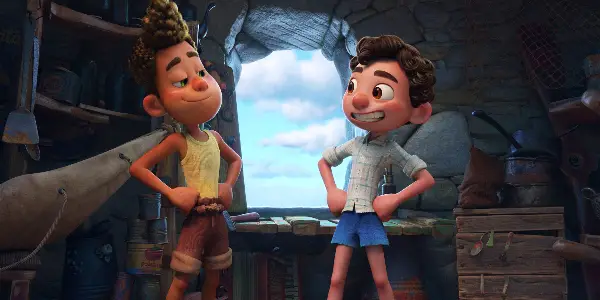
Luca and Turning Red are incredible examples of that second approach, demonstrating how a compelling and personal story told well can easily become universal. The film follows a 13-year-old sea monster, Luca (Jacob Tremblay), who yearns to be where the people are in the coastal Italian town of Portorosso. The rebellious, scrappy mer-kid Alberto (Jack Dylan Grazer) is all too happy to absolute-nightmare his way into Luca’s sweaterboy life, launching both of them into the human world and into an adventure that’s beyond both of them.
Luca is a movie about blazing your own trail, making new friends, and eating a lot of pasta. But beneath the surface, Luca also manages to capture the heartbreaking tribulations of queer childhood. Its closeted protagonist hates who he is and just wants to be normal — to enjoy the quiet village life and become friends with the human girl Giulia (Emma Berman). But Alberto is proud of who they are and tries to make Luca see that they shouldn’t be ashamed just because the rest of the world thinks they’re monsters. From the beginning of the third act, when Luca pushes Alberto away, to the go-for-broke triathlon climax in the rain and the devastating final scene, I always bawl whenever I rewatch Luca. It might not have talking fish or puberty metaphors, but… oh, wait, no, it has both of those things. Luca rules. –Clement Tyler Obropta
Does content like this matter to you?
Become a Member and support film journalism. Unlock access to all of Film Inquiry`s great articles. Join a community of like-minded readers who are passionate about cinema - get access to our private members Network, give back to independent filmmakers, and more.