



Hannah Ammon knew she wanted to write and direct, she just wasn’t sure when the right moment would arrive. Her short film, We Do Our Best, grew out of a feeling she couldn’t quite shake. Sometimes, those ideas don’t let go. Sometimes, out of those ideas, are born a natural, talented, storyteller. Enter Hannah Ammon.
“Over the years it kind of took on different meanings,” Ammon says. “It was a memory that stuck with me forever, and I kept coming back to it. And when I was getting ready to finally write something, I was like, ‘This is it.’ It just kept poking out.”
The advice to “write what you know” is familiar, but Ammon takes it to heart. The result is a quietly moving ode to mothers and daughters; and to the everyday effort of simply getting through a day.
That persistence translated into a short film that is intimate in scale yet emotionally expansive, unfolding over the course of a single night between a mother and daughter. Confident without being showy, We Do Our Best opens up something far larger about memory, womanhood, and the shifting gravity of a relationship in motion.
The film has already begun finding its footing on the festival circuit, premiering at the Stony Brook Film Festival before heading west to HollyShorts in Los Angeles, and now screening at the Beverly Hills Film Festival, an encouraging run for a debut that understands the power of emotional specificity. “It’s been very exciting,” Ammon says, still sounding slightly stunned by the momentum. “What a whirlwind.”
The film’s emotional foundation is rooted in Ammon’s own adolescence, growing up in New York City in a household defined by creativity and expression. She attended a performing arts high school, while her mother worked as a painter; an upbringing that informs the film’s texture without tipping into autobiographical. These details surface naturally throughout the short, never feeling heavy‑handed or instructive.
At the center of the story is one particular evening when mother and daughter step outside the confines of their small downtown apartment. At the time, it didn’t register as anything especially significant. “It didn’t seem so huge to me as a teenager,” Ammon admits. “We take these things for granted.” But the memory lingered, quietly accruing meaning as the years passed.
By the time she sat down to write the film, that single night had become unavoidable; not because of what happened, but because of what it revealed. The shift in perspective, once invisible, now felt essential.
From its opening image (paintbrushes soaking in a sink) the film immediately establishes how closely art, memory, and identity are intertwined. The image nods directly to Ammon’s mother, but also serves as a subtle thematic cue. “It’s hard not to be inspired by my mom,” she says. “She’s such a beautiful, artistic, creative person.”
The visuals speak quietly but clearly. The blending colors mirror the parent‑child relationship itself: similarities bleeding into difference, individuality shaped by proximity. “The paintbrushes in the beginning: it’s like this mesh of different personalities we have with our parents,” she explains. “Things that are similar and things that are different. And absolutely, it’s a nod to her. I even have one of her actual paintings hanging in the apartment.”
That sense of layering carries throughout the film, which gently documents a shift in perspective between mother and daughter that feels profound. Beneath the surface lies a familiar but unsettling realization: that parents are not static figures, but people still figuring things out in real time.
At its simplest, We Do Our Best unfolds over one night. A mother and daughter slip into a neighborhood bar, pretending the daughter is older than she is. They share a drink, people‑watch, trade stories, and, almost without realizing it, begin to share truths that subtly alter the terms of their relationship. They see each other in a new, unfettered light. What starts as playful pretense opens into something more revealing, allowing them to briefly meet as equals before returning to their respective roles changed.
That emotional premise made casting particularly delicate. Because the film draws so closely from Ammon’s own life, she wasn’t just searching for strong performances, but for actors who could convey a sense of lived‑in history and unspoken understanding.
The role of the mother ultimately went to Jennifer Esposito, who also joined the project as a producer—an outcome that initially felt unlikely. “I was getting really down to the wire with casting,” Ammon recalls. “When someone suggested Jennifer Esposito, I was like, ‘No way—she’s not going to read my script.’ But she got back to me almost immediately and just jumped on board.”
Esposito brings a spontaneous, youthful energy to the role, particularly in the bar scenes, where the mother’s own sense of curiosity briefly resurfaces. “She’s such a bright light,” Ammon says. “There’s a playfulness to her—like, ‘Let’s go into this bar. Let me shake out my hair.’ She brought so much joy to it.”
Opposite her, Madeline Mathews plays the daughter, a casting choice shaped as much by personal alignment as by performance. “We went to the same high school and had pretty parallel lives,” Ammon says. Despite never meeting prior to filming, Mathews and Esposito quickly developed an ease that translates onscreen. “Their chemistry just worked,” Ammon adds. “I got really lucky.”
Together, their performances ground the film’s central idea: that briefly stepping outside prescribed roles—pretending to be someone else for the night—can expose deeper truths.
“We’re all here for the first time,” Ammon reflects. “And when we’re kids, we just expect our parents to have done this before. It’s such a humanizing moment to realize your mom or dad had a life before you—that they were a person, just like yourself.”
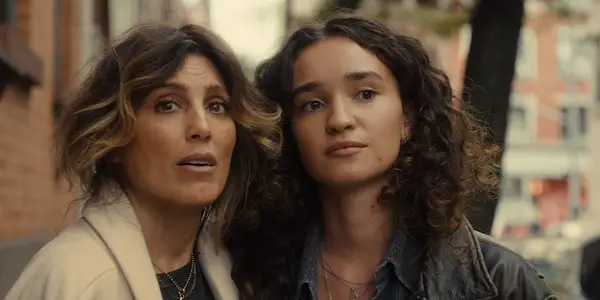

For Ammon, that realization was transformative. “I think my mom and I kind of saw each other as women for the first time,” she says. “And when you’re put in a situation where you can play pretend, it reveals truths at the same time.”
The mother‑daughter dynamic resists easy conflict or sentimentality. Instead, it exists in a shifting balance of caregiving, vulnerability, playfulness, and restraint. The film makes space for joy alongside recognition, suggesting that understanding doesn’t always arrive through confrontation, but through shared openness.
In addition to writing and directing, Ammon also composed the film’s music alongside longtime collaborator Joe Wagner, marking her first time scoring a film. Drawing from the artists she listened to in high school, the score situates the film firmly in the early 2010s. “We basically created a jukebox of songs you’d want to hear in the bar,” she says.
One track, “Turbulence,” appears in the film and later became part of Ammon’s music project, another example of how seamlessly We Do Our Best blends personal realism with creative expression.
Although early versions of the script existed years earlier, Ammon is grateful she waited to make the film when she did. “I’m 30 now, and I’m really glad I waited,” she says. “You have to get older to really understand the layers of these moments, especially with your parents.”
Audience reactions have affirmed the film’s emotional universality. Viewers often tell Ammon it reminded them of a moment with their own mother or father; sometimes cherished, sometimes unresolved. “Especially mothers,” she notes. “It seems to hit something tender.”
And her own mother’s response? “She loves it,” Ammon says. “She’s been to most of the festivals. She always steals the show.” More than anything, Ammon hopes the film feels honest. “I hope it does her justice.”
Looking ahead, Ammon is beginning to develop new projects set in similar emotional territory. “I don’t really see this as a proof of concept,” she says. “The proof is in the women themselves and the dynamic. There’s so much beautiful gray area to explore.”
For emerging filmmakers, her advice is simple, if not easy. “You never know who’s going to say yes,” she says. “Just try. Send the script. Go for it.”
At its heart, We Do Our Best feels like a quiet love letter to mothers and daughters, to New York, and to the fleeting moments that gently, irrevocably reshape how we see one another. As Ammon puts it, “We’re all here for the first time. We do our best.” It’s a beautiful sentiment and one that truly sticks. Ammon is the real deal.
We want to thank Hannah Ammon for speaking with us. For more information on the film click here.
Does content like this matter to you?
Become a Member and support film journalism. Unlock access to all of Film Inquiry`s great articles. Join a community of like-minded readers who are passionate about cinema - get access to our private members Network, give back to independent filmmakers, and more.