



This year’s Oscar-nominated Live Action Short Films are screening theatrically together in a program distributed by Roadside Attractions. However, apart from all being nominated for the Oscar, these films have very little in common. They include a musical comedy set in a dark bar, a heartwarming story of unlikely friendship, a social drama about a Palestinian butcher in Israel, an absurdist romance about people forbidden from kissing, and a silly satire of Jane Austen involving the menstrual cycle. Combined, they run approximately two hours; with such variety to offer, you’ll likely find something to love, no matter your taste in film.
The Singers
Inspired by a short story by Ivan Turgenev, The Singers takes place over the course of one evening in a dark bar populated by the destitute and downtrodden. Directed by Sam A. Davis, the film captures a spontaneous sing-off between the patrons, played by a range of performers found via televised talent shows, the Internet, and street casting. The result shows us that even the most seemingly hardened of men can possess (and express) hidden depths of vulnerability.

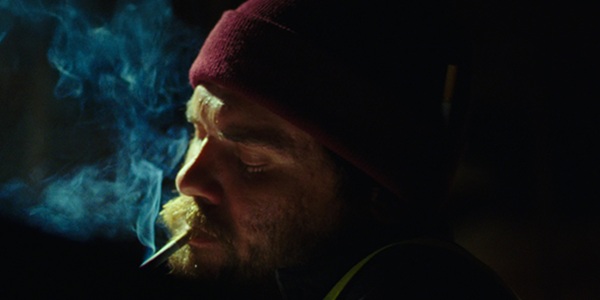
The lead-up to the sing-off introduces us to the characters by showing them sitting at the bar (or standing behind it), complaining, arguing, drinking, and smoking. These men all have a gritty, realistic look and attitude that suits the setting; if you’ve ever been in this kind of dive, you’ve met these kinds of lonely, embittered people. However, the ones you met may not have been able to belt out such soulful renditions of “Unchained Melody” and other standards as Michael Young, Chris Smither, Will Harrington, Judah Kelly, and Matt Corcoran do in the film.
I enjoyed the gorgeous, stripped-down renditions of songs performed in The Singers, as well as the rich 35mm cinematography courtesy of director Davis. The film takes Turgenev’s 1850 story and removes it to the present day, but in the dimly lit glow of the bar, you can easily be convinced the setting is any time and place in the world. It’s a film of simple, raw emotion that urges men to express their inner feelings rather than keep them bottled up inside (or in liquor). Nonetheless, it did leave me wanting something more; when the closing credits rolled, I was surprised the film was already over. Perhaps the story is, in the end, too simple: if you just burst out in song (and sound as amazing as these guys do), then maybe you’ll feel better about life! Or maybe you’ll just annoy everyone else in the bar. Who can say?
A Friend of Dorothy
Directed by Lee Knight, A Friend of Dorothy is a lovely depiction of the unlikely friendship between a 17-year-old actor and an elderly woman in need of companionship. To paraphrase Dorothy, played to unfiltered, effervescent perfection by Miriam Margolyes, people her age are often dismissed as burdens; people don’t realize that they still have souls. The film, supported by the charity Age UK, portrays the elderly in our communities as people who not only still have needs, but also have so much more to give.

One afternoon, J.J. (Alistair Nwachukwu) accidentally kicks his soccer ball into Dorothy’s back garden; when he knocks on her front door, she invites him in to open a can of prunes for her (she has no hesitation describing why she needs them at her age). Taken aback by the extensive collection of plays lining Dorothy’s bookshelves, J.J. tells her he does drama at school. A lifelong patron of the arts, Dorothy invites him to read some lines from Matthew Lopez’s The Inheritance, set in the aftermath of the AIDS epidemic. What follows is a fast friendship between two people who seem to be the only ones who see each other for who they really are. And while their time together is unfortunately brief, it is clear by the end that it has changed both of their lives for the better.
A Friend of Dorothy is the cinematic equivalent of a warm cup of milky tea: deeply comforting, but rather unadventurous. The characters would barely rise above archetypes if it weren’t for the wonderful performances by Margolyes and Nwachukwu, whose chemistry cannot fail to move you. (Bonus points for Stephen Fry popping up in a small but pivotal role.) Still, it’s impossible not to like a film that packs this much heart into twenty-two minutes.
Butcher’s Stain
Butcher’s Stain tells the story of Samir (Omar Sameer), a Palestinian butcher working at an Israeli supermarket who is falsely accused of tearing down the posters of the Israeli hostages that hang in the staff break room. Why hostage posters would need to be hanging in the break room is beyond me – they’re hostages, it’s not like the employees are going to see them on the street and be able to save them—but the event is treated as a symptom of rising prejudice against Palestinians following October 7 (never mind the decades of persecution before that).
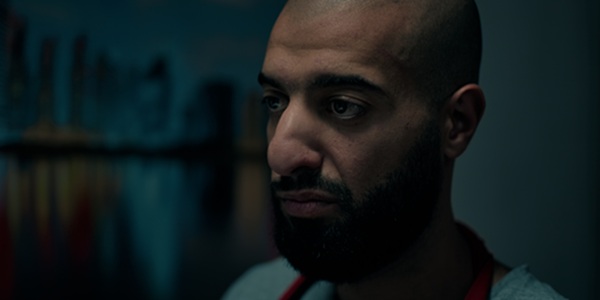
Before the accusations, Samir is a pretty cheerful guy, with nice words for his customers and coworker Nir (Meyer Levinson-Bount, a film student at Tel Aviv University, who also directed the film), even as other colleagues give him the side-eye and his ex-wife tries to thwart his shared custody of their son. But when he is accused of something he knows he did not do, based on anonymous eyewitness testimony that he knows is a lie, he begins investigating his coworkers and discovers that not everyone is who they pretend to be.
Butcher’s Stain means well, but doesn’t take a strong enough stance to be truly effective. Levinson-Blount seems to be saying to fellow Israelis, “not all Palestinians,” while saying to the rest of the world, standing in judgment of Netanyahu’s genocide, “not all Israelis.” In trying to get multiple messages across and touch on multiple hot-button topics, it ends up saying less than it could have with a sharper focus. Still, Sameer is excellent, laying bare the frustration of being subject to deeply ingrained discrimination and accused of supporting terrorism just because he is against children being killed in Gaza. And the final reveal of how the posters are actually coming down off the wall is bitterly funny, as is Samir’s reaction to the discovery.
Two People Exchanging Saliva
The standout in this year’s slate of nominees is Two People Exchanging Saliva, a dystopian romance set in a world where the only currency is slaps to the face and the punishment for kissing someone is death. Directed by Alexandre Singh and Natalie Musteata, the 36-minute film from France establishes the absurd world in which its characters exist more efficiently and enjoyably than most two-hour-plus blockbusters. Corner stores hawk garlic gum so that you can ensure your breath is bad enough to get through security on your way into work; meanwhile, toothpaste is something bought illicitly on the black market for two slaps in a back alley. And only if you have enough money to make frequent purchases—and thus, be slapped—are you able to experience anything close to physical intimacy in your everyday life.

It’s in this strange world—captured in gorgeous, high-contrast black-and-white by cinematographer Alexandra de Saint Blanquat and narrated by Vicky Krieps—that a young woman named Malaise (the charming Luàna Bajrami, who stole scenes as Sophie in Portrait of a Lady on Fire) begins working at a classy department store. When she sees a glamorous customer named Angine (the always-excellent Zar Amir), she is immediately drawn to her, telling her they’ve been friends for a long time. The two women bond hard and fast, to the point that Angine begins compulsively shopping just so she can be slapped by Malaise every time she makes a purchase. (And it’s a lot of slaps—sometimes upwards of fifty for luxury items!) But senior saleswoman Pétulante (Aurélie Boquien) is growing dangerously jealous of their burgeoning relationship…and when she overhears Malaise secretly brushing her teeth in the bathroom, she begins to suspect the worst. (Honestly, the most unbelievable thing in the film is that anyone still has all their teeth in a world of such widespread dental neglect.)
When I first heard about Two People Exchanging Saliva, I was hesitant. A cast of established actresses playing characters with obnoxious symbolic names in a black-and-white short film, with that title to boot? It sounded unbelievably pretentious, as though it was cobbled together in a lab to receive the maximum amount of attention from cinephiles on the Internet whose patron saint is Yorgos Lanthimos. Yet the reality blew me away. It is a marvel of world-building; everything in every frame is meticulously crafted and highly specific, including the amazing costumes by Rezvan Farsijani: from Angine’s high-fashion ensembles to Malaise’s sharp-shouldered salesgirl uniform. The performances are heartrending, and the ending is quietly devastating. While it’s not the only one of this year’s nominees that I enjoyed, it’s the only one I would classify as a must-see.
Jane Austen’s Period Drama
I question the judgment of whoever decided to follow the sad-girl masterpiece that is Two People Exchanging Saliva with a satirical comedy about a woman in a Jane Austen-style romance getting her period, mostly because I think I would have enjoyed the latter far more if I had not just been sideswiped by the former. The only thing they really have in common is that they both saddle their characters with annoying names; in Jane Austen’s Period Drama, those names include the likes of Estrogenia, Dickley, and even Vagianna. But despite some cringeworthy humor in that vein, the film—directed by Julia Aks, who also stars as the unfortunate Estrogenia, and Steve Pinder—is a witty look at society’s unfortunate reluctance to talk about something that is a matter of life for approximately half of the world’s population.

It’s England in 1813, and Estrogenia is in the midst of a melodramatic scene with the man she loves, Mr. Dickley (Ta’imua), when he shocks her by proposing marriage. However, before she can joyfully assent, Mr. Dickley notices blood down the front of her skirt and assumes she has been grievously injured. In fact, she has just gotten her period early, without the necessary precautions (rags, yikes). Back at the house, a concerned Dickley runs to fetch the doctor, while Estrogenia’s sisters Labinia (Samantha Smart) and Vagianna (Nicole Alyse Nelson) try to help her decide what to do. Should she tell Dickley she’s just menstruating? Does he even know what menstruation is? Will the truth scare him away?
I am a big believer in normalizing talking about menstruation, and I am also a big fan of Jane Austen…though, combining those two things in one film is not something I ever would have thought of, or anticipated anyone else thinking of, either. And while I didn’t love everything about the execution of that novel concept in Jane Austen’s Period Drama—the character names just irritated me, and some of the performances were a tad weak—I do think it’s delightful that a movie so silly and vulgar made it onto an Oscar shortlist. After all, stories don’t always need to be self-serious to deserve acclaim!
This year’s Oscar-Nominated Shorts, distributed by Roadside Attractions, open in theaters in the U.S. and Canada on February 20, 2026.

Does content like this matter to you?
Become a Member and support film journalism. Unlock access to all of Film Inquiry`s great articles. Join a community of like-minded readers who are passionate about cinema - get access to our private members Network, give back to independent filmmakers, and more.