



In recent years, there has been no shortage of coming-of-age films centered on young women exploring their newfound sexuality. The latest of these is Little Trouble Girls, the feature debut of writer-director Urška Djukić and Slovenia’s submission for Best International Feature Film at this year’s Academy Awards. The film, which takes its title from the Sonic Youth song that plays over the end credits, chronicles one incredibly complicated weekend in the life of a teenage girl during choir rehearsals at a convent. And while the film’s charged exploration of the complex interplay between female friendship and sexuality (with a hefty side of Catholic guilt) has earned it comparisons to earlier films like Céline Sciamma’s wonderful Water Lilies, Little Trouble Girls is so beautifully crafted that it deserves to be recognized on its own merits.
Losing Her Religion
When Lucia (Jara Sofija Ostan, who bears a striking resemblance to young Adèle Exarchopoulos in both talent and beauty), a sheltered and introverted 16-year-old, joins the all-girls choir at her Catholic school, a whole new world suddenly opens up before her. At the center of this world is Ana-Maria (Mina Švajger), a popular older girl who invites Lucia into her inner circle and, through the sacred rituals typical of teenage girls (spin the bottle, truth or dare), initiates Lucia into one of the most universally recognizable phases of adolescence: the one where you are desperate to pretend that you are more worldly and adult than you actually are.

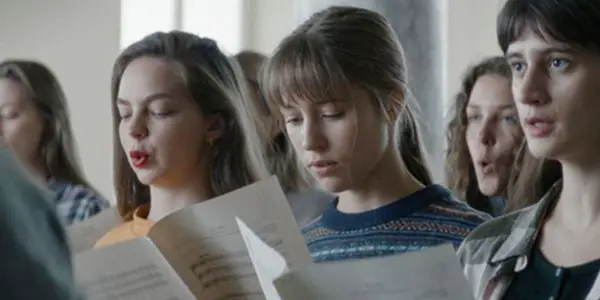
When the choir heads to a rural convent for a weekend of intensive rehearsals, the close confines, coupled with the presence of male construction workers, spark a fire that threatens to burn through the entire group. Whether she’s kissing a statue of the Virgin Mary while Ana-Maria watches hungrily, or sharing a charged gaze with a particularly handsome worker, Lucia is caught in a maelstrom of sexual tension unlike anything else she has experienced before; her guilt and shame over the perceived immorality of her desires leads her to question the faith that has been the backbone of her life thus far. And when she shares her worries with the one adult present whom she thinks she can trust—the choir’s male conductor—her reward is to be cruelly shamed in front of the whole choir in a series of brutal rehearsal scenes that sting like alcohol being poured onto a fresh wound.
Guilty as Sin
Little Trouble Girls is an incredibly sensual film, from the richly layered sound design that fills each scene to bursting (complete with undercurrents of frantically whispered prayer) to the stunning use of close-ups that add to the film’s almost claustrophobic intimacy. And unlike some other films with similar subject matter—Blue is the Warmest Color comes to mind—Little Trouble Girls looks upon its characters with an unmistakably female gaze, one that treats the young women at its center as more than objects to be ogled for audience gratification. Ostan, in a remarkable debut film performance, brings a beguiling mix of naivety and curiosity to the role of Lucia, while Švajger skillfully gives glimpses of the confused, complicated girl Ana-Maria really is behind the confidence she wields like a shield. It’s easy to see why Lucia is fascinated with Ana-Maria, and why that fascination straddles the line between wanting her and wanting to be her.
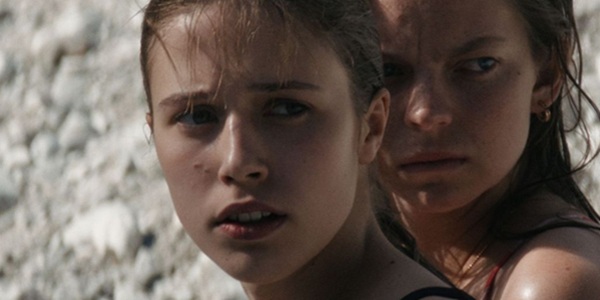
Throughout the film, the choir scenes sound beautiful but feel nonetheless tightly wound and controlled, with the girls forced to stand, dress, and sound a certain way so that no one stands out from the crowd. Conversely, when Lucia comes upon a group of nuns singing together privately in a cave, the scene feels full to overflowing with a sense of freedom and joy. Their faith does not rely on guilt and meanness, and it rings far truer to Lucia than the faith forced upon her by the authority figures in her life. At one point in the film, Ana-Maria feeds Lucia unripe grapes and compares the sour taste to punishment for one’s sins; later, Lucia buys herself ripe grapes at a market and revels in their sweetness without shame.
The main fault of Little Trouble Girls is that it relies a little too heavily on symbolism that is a little too heavy-handed, particularly the recurring motif of flowers in bloom, ready to be pollinated by the bees hovering nearby. For a film that is otherwise so sensitive and subtle for a first feature, these shots feel like they were pulled straight from a student film and are almost giggle-inducing in their obviousness. The film also rushes its final act in a way that leaves one feeling as though Djukić didn’t quite know how to end her story—though, of course, for Lucia, this is less of an end than a beginning anyway. Still, there is so much here to appreciate that it’s easy to forgive Little Trouble Girls these small weaknesses.

Conclusion
Little Trouble Girls takes a lovely, lyrical approach to time-worn tropes, the result of which is a film that entrances the audience despite its flaws.
Little Trouble Girls opens at the IFC Center in New York on December 5, 2025, and at the Laemmle Monica Film Center in Los Angeles on December 12, 2025.

Does content like this matter to you?
Become a Member and support film journalism. Unlock access to all of Film Inquiry`s great articles. Join a community of like-minded readers who are passionate about cinema - get access to our private members Network, give back to independent filmmakers, and more.