


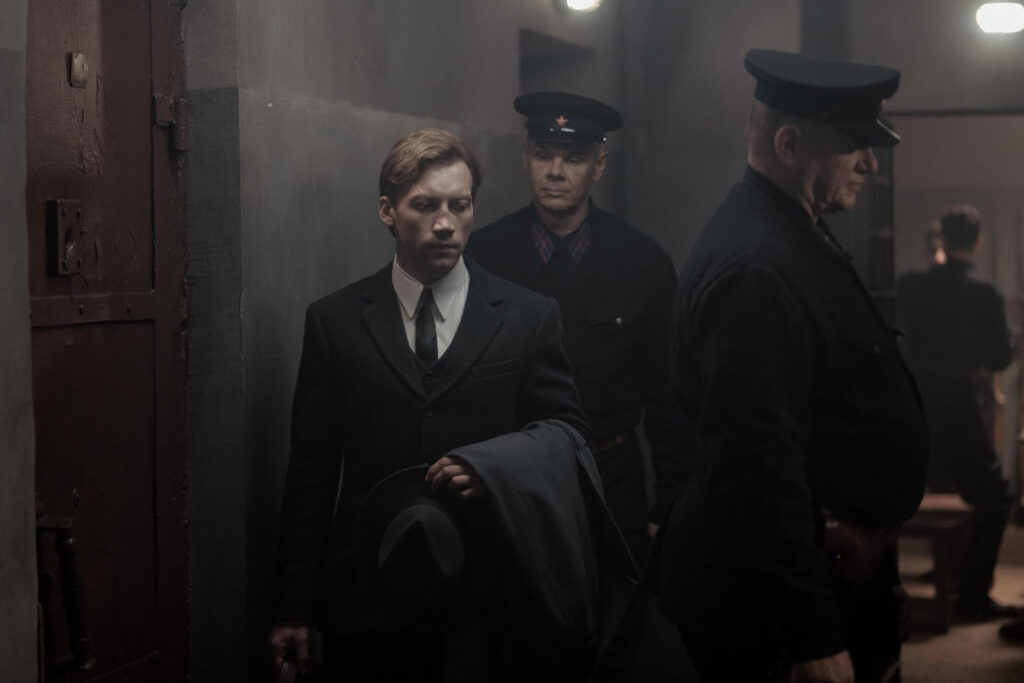
Sergei Loznitsa’s Two Prosecutors begins with an unlocking. A dark red gate opens and thin, bedraggled prisoners of the gulag slowly tip out. It may be an unlocking, but glasnost this isn’t. It’s 1937 USSR, the height of Stalin’s Great Purge. Of the prisoners, each dressed like Beckettian tramps in clothes too big for their starved frames, the oldest prisoner, a sack of letters slung over his shoulder, is tasked with burning them.
With a sedate pace present throughout Two Prosecutors, reflecting the enforced languidness of Soviet bureaucracy, we stay on the old prisoner as he reads a few letters, all sent by prisoners like himself, none of them reaching their destination. Until he opens one, written on improvised paper in the author’s blood, demanding a meeting with the local prosecutor. It’s this grim message that makes its way out, stashed on or in the old man, and starts the film’s story proper.
Kornyev: A Principled, Virginal Lead Prosecutor
Aleksandr Kuznetsov’s Kornyev is the story’s protagonist and main of the two titular prosecutors, a young law graduate who’s arrived at the gulag to follow up on the prisoner’s bloody demand. The prisoner Stepniak (Aleksandr Filippenko) is our second prosecutor, tortured and dying, pulled down by the state from his old heights where he gave lectures like the one that, it’s revealed, inspired Kornyev to fight for truth, justice, and the Soviet way — the very fight that’s led him to Stepniak and set the story in motion.
Kuznetsov plays the serious and solemn young prosecutor with a steely, sparsely worded determination. He smiles once throughout the film. It’s a smart choice, contrasting the flippant joviality of the powerful as they brutalize citizens. Anyway, Kornyev’s goal isn’t happiness; it’s to uphold the de jure law in the face of the de facto law.

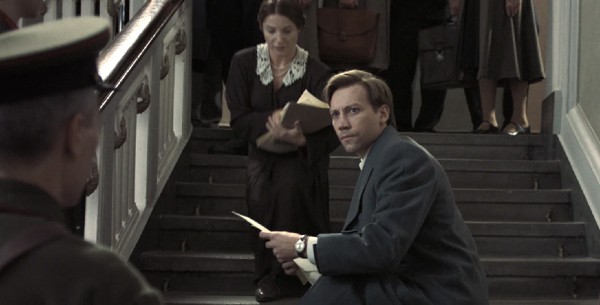
In short, Kornyev is principled. But having principles in this world is naive — something characters tell him over and again. This “immaturity” is symbolized in references to Kornyev’s virginity. Loznitsa’s script (adapted from a Georgy Demidov short story, himself a political prisoner) adroitly keeps alive the hope that he might succeed in tandem with the sense of inevitability that this naïveté/principle will rip Kornyev’s symbolic virginity from him: If he carries on with this green devotion to law and principle, he’s going to get fucked.
Scenes Are Long – But Lived In
The regime’s bureaucracy slows everything to a crawl. It’s credit to Loznitsa and editor Danielius Kokanauskis that despite the film’s glacial pace, our attention doesn’t wane while each guard, each supervisor, each comrade with a set of keys in the film — perhaps with Kornyev’s interest at heart — wishes that the young prosecutor’s own attention will. We see every step Kornyev has to fight for, each door pushed open with a palm or unlocked with a key. Each person ahead of him in the waiting room being called in. Each bureaucratic step, each delaying tactic. Scenes are long but, crucially, lived in.
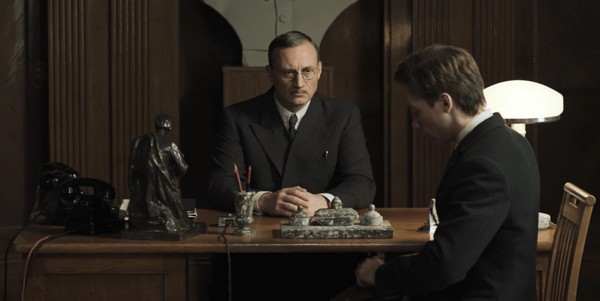
No more so than in the numerous scenes of long conversation, like the extended, intense scene between the two prosecutors themselves, where veteran Russian actor Filippenko brings his real-life experience of Soviet Russia to bear in his intense, beady-eyed gaze, and hunched, battered physicality. His physical performance is unsparing but never gratuitously grim, and his mental eloquence strong enough for us to imagine what it would have been like before the gulag and, in turn, enabling us to believe how he might’ve inspired a young law student like Kornyev.
And crucially, this is no tale of outsiders as the good guys. Kornyev is a true Party member, as is Stepniak, an old Bolshevik who has the old — and now new — physical scars to testify to his beliefs. The brutality of the gulag, the two prosecutors tell us, is not an effect of Bolshevism, Marxism or Communism, but a flouting of it.

Morality In The Mise-en-scène
Even in the muted colors of Yuriy Grigorovich and Aldis Meinerts’ production design, there’s room to reflect the morals of Stalin’s USSR in the visuals. In Dorota Roqueplo’s costume design, Kornyev’s grey overcoat contrasts the muted monochrome of the Communist bureaucracy, reflecting a nuanced worldview of grey areas amidst the Stalinist black and white world.
But beneath Kornyev’s overcoat is a suit more starkly monochrome, revealing that it’s Kornyev who has the stronger sense of right and wrong, black and white, than those he’s struggling against. Because despite the regime’s brutality, it’s their notions of good and bad that’s up for grabs, their morality endlessly malleable based on what’s politically convenient for them.
Conclusion
Two Prosecutors is an austere and purposefully unhurried story of people who seek to uphold the law in a world where the law prioritizes political expediency at any time changeable and at any cost. Its pace may test the patience of some, but the sparse but thoughtful visuals and smart performances will reward those willing to follow Kornyev’s stifled pursuit of justice as well as anyone with an interest in Soviet history.

Two Prosecutors is due to be released in 2026.
Does content like this matter to you?
Become a Member and support film journalism. Unlock access to all of Film Inquiry`s great articles. Join a community of like-minded readers who are passionate about cinema - get access to our private members Network, give back to independent filmmakers, and more.