



The earliest known English-language book to be authored by a woman is thought to be Revelations of Divine Love, written by Julian of Norwich in the 14th century. An anchoress who withdrew from secular society to lead an isolated life within a cell attached to St. Julian’s Church in Norwich, England, Julian spent her days devoted to writing and prayer; little else is known about her, including whether her given name was indeed Julian or whether she took the name of the church where she lived. Nonetheless, she and her work come to vivid life in filmmaker Caroline Golum’s sophomore feature, which boasts a highly stylized, homespun aesthetic that is guaranteed to charm you.
Medieval Times
Revelations of Divine Love opens with Julian (newcomer Tessa Strain) living at home with her family before her consecration and enclosure as an anchoress. At the age of 30, she falls so ill that a priest is called to deliver her last rites. While poised on the slippery border between life and death, Julian has numerous visions of the Passion of Christ; after she survives, she decides to devote the rest of her life to living as an anchoress and writing about her visions.

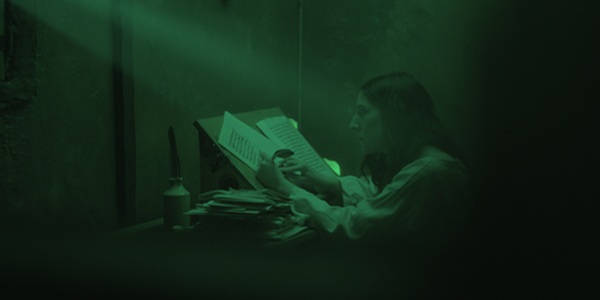
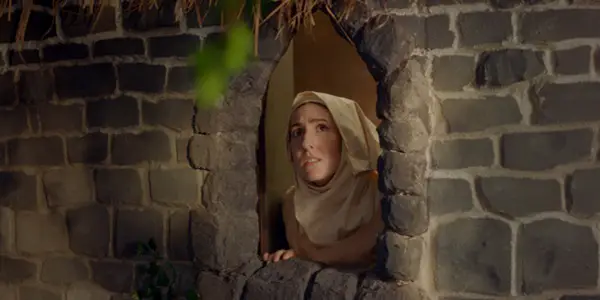
The film then follows Julian (or rather, hovers within and outside of the cell in which she resides) as she provides spiritual guidance to the people of Norwich, shares her writings with visitors to her cell, and observes the plague wreaking havoc on the lives of those around her. The world in which she exists is constructed through handmade sets and painted backdrops that are as vibrantly colored as a medieval illuminated manuscript and much more tactile, with the visible texture of the paint and cardboard somehow making Julian’s mystical life feel more grounded in reality than the most extravagantly, realistically detailed production design ever could.
Divine Intervention
Echoing the visuals’ embrace of artificiality, the actors in Revelations of Divine Love all speak in a formal, highly articulated diction (thankfully not the Middle English in which Julian originally wrote) that helps transport the viewer to another time. Strain is perfect in the lead role, with a distinctive, timeless face that would be right at home in a religious painting from the Middle Ages, especially when surrounded by the heavy white folds of her cowl. Indeed, the casting across the board is excellent, with no distractingly modern iPhone faces anywhere to be found.
However, what really makes Revelations of Divine Love stand out are the feverishly psychedelic renderings of Julian’s visions, which straddle the line between the vintage 20th-century fantasy art (like the kind created by the titular character in the 2018 Panos Cosmatos film Mandy) and modern horror (like everything else that happens in the 2018 Panos Cosmatos film Mandy). From the theatrically bright blood dripping from the wound in Jesus’s side to the black-clad demons that emerge from the darkness to claw at Julian in her bed, these striking images stick with you long after the film’s conclusion, and make you eager to see Golum and her collaborators—especially art director Grant Stoops and costume designer Nell Simon—apply their distinctive style to another cinematic story sooner rather than later.
Conclusion
A feminist undercurrent runs through Revelations of Divine Love, reminding us that Virginia Woolf was right: one of the most important things a woman needs to be able to write is a room of her own in which to do it. That Julian of Norwich had one, albeit one that she was (voluntarily) confined to for the rest of her life, is one of the main reasons why we remember her today; if she had not been able to write her story, we would never have known she existed, or had the treat of watching such a delightfully crafted film version of her life.
Revelations of Divine Love opens at Anthology Film Archives in New York on March 27, 2026, as part of the series Revelations of the Middle Ages, guest-programmed by Golum. Additional screening information can be found here.
![Revelations of Divine Love [Official Trailer]](https://i.ytimg.com/vi/QuKics1aoFc/hqdefault.jpg)
Does content like this matter to you?
Become a Member and support film journalism. Unlock access to all of Film Inquiry`s great articles. Join a community of like-minded readers who are passionate about cinema - get access to our private members Network, give back to independent filmmakers, and more.