











THE DISASTER ARTIST: Almost as Fun as THE ROOM Itself


Bad movies are rarely celebrated to the extent of Tommy Wiseau‘s The Room. It’s that rare film that, though not alone in the category of “so bad it’s good,” just has something special about it all the same – whether it’s the abysmal production value, the bizarre and nonsensical story, or Wiseau‘s own all-or-nothing acting. Now, nearly 15 years later, people still talk about it: seeing it at midnight screenings, dressing as their favorite characters, and interacting with the silly events transpiring on screen, in a way similar to The Rocky Horror Picture Show.
As an adaptation of Greg Sistero‘s book, The Disaster Artist delves into Sistero and Wiseau’s original friendship, their attempts to make it in Hollywood, and their eventual progress on their creation of The Room. Through this translation, though, some of the nitty gritty details of their conflicted partnership are somewhat glossed over, and the film is not as impactful as the writing itself. Yet, perhaps this isn’t such a detriment after all, as James Franco knows and understands just what makes The Room so endearingly entertaining.
The Enigma of Tommy Wiseau
The Disaster Artist begins in San Francisco at an acting class. Greg Sistero (Dave Franco) is a young aspiring actor, and is nervously stumbling through a reading on stage, only to be scolded by his teacher for his lack of passion. As if to show him how it’s done, following his performance is a tall, strange-looking man with dark, wavy hair – who triumphantly approaches the center and reads the pivotal scene of A Streetcar Named Desire – his shrieks of “STELLA!” aligning with flamboyant gestures and erratic movements across the stage. Within moments, he has the entire audience in an uproar.
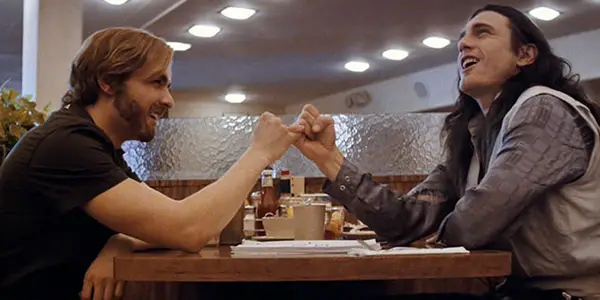
Such is our first impression of James Franco‘s Tommy Wiseau, and what an impression it is. Franco somehow manages to portray Wiseau’s eccentric mannerisms without once resorting to caricature, imitating his unplaceable accent, his faraway, glazed look, and his steadfast, unmitigated way of interacting with others. It’s a performance that immediately draws you into the film’s events, forgetting that you are seeing Franco play Wiseau as opposed to Wiseau himself.
Sistero is similarly captivated by Wiseau’s passion, approaching him in order to read a scene with him the next time they meet. Such begins their partnership, which leads to a rather awkward lunch reading, throwing a football around aimlessly, and watching a James Dean movie. It eventually leads into them moving in together at Wiseau’s apartment in Los Angeles (don’t ask how he can afford an apartment in both San Francisco and L.A.), and, finally, the production of The Room.
Book to Screen
It’s in the minute details that I was tempted to be nitpicky with The Disaster Artist. It tends to mash together or otherwise alter several distinct aspects of Sistero and Wiseau’s friendship, including how they were often at odds even from the start, the timeline of how they ended up settling down once they moved to L.A., and how The Room was almost exclusively Wiseau’s creation that Sistero reluctantly came on board with.
It’s a change that I wasn’t immediately sold on, preferring Sistero’s building up in the book of Wiseau as a Norma Desmond-like character, with The Room eventually becoming his “the world took pity” moment. The Disaster Artist does hint at this turmoilic partnership at times, especially towards the end, but it’s not nearly as developed.

In a way, though, Franco‘s more breezy approach to the material also makes The Disaster Artist into more of a buddy film, showing how two people supported each other in their attempts to reach for their dreams (it also helps that the two are played by actual brothers, Dave and James Franco). In addition, The Room itself is celebrated as a nonsensical work to simply nonsensically enjoy. To make The Disaster Artist into a much bleaker film would have been at odds with that. So, though I’m notably biased given my enjoyment of the book, I believe Franco‘s adaptation suitably works.
“Oh, hi Mark!”
Where The Disaster Artist unarguably succeeds is in its meticulous restaging of the key events of The Room. The film, which even shows a side-by-side comparison after the credits roll, is ambitiously and respectfully spot on when it comes to its original subject. Essential questions behind the scenes are raised as well – “does the cancer thing ever come up again?” “Why is his bare ass showing so much during the sex scene?” “Why does Johnny laugh after Mark says a woman ended up in the hospital?”
The cast, other than the aforementioned Franco brothers, also includes Seth Rogen as the often-scratching-his-head script supervisor Sandy Schklair, Ari Graynor as the devious love interest Juliette Danielle, who plays Lisa in The Room, Josh Hutcherson as Phillip Haldeman/Denny, and Zac Efron in a memorable role as Dan Janjigian, who plays Chris-R (in a 2-minute role that fans recognize as by far the greatest performance of The Room). All in all, you can tell that the cast had a genuinely fun time making not only The Disaster Artist, but The Room as well, shedding light on the original cast members and crew who had to endure the actual process of dealing with Tommy Wiseau.
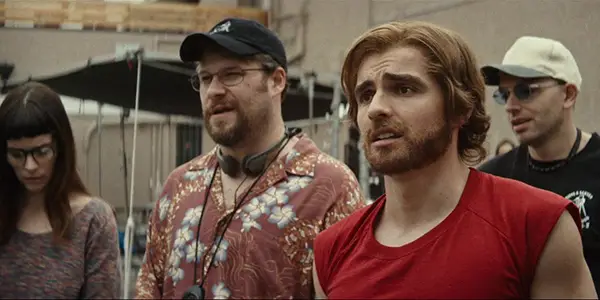
The Disaster Artist, like the book, also peels back the curtain a bit on the filmmaking process, showing how the script supervisor and other crew members work behind the scenes, how the crew interact with the cast, and how behind-the-scenes moments can influence the actual filming itself. It also shows how, even if there is professional talent behind or in front of the screen, the resultant film can be an absolute disaster, especially if helmed by someone with such an outlandish worldview as Tommy. It’s a surprisingly insightful glance at filmmaking, that many people may not actually see or think about when watching a movie.
It’s even more impressive when you think about the fact that the cast and crew on the production of The Room are themselves actors. Going even further, James Franco is playing a character who is playing a character and is also a director playing a director. To go through so many layers and to play so many intricate roles is, to me, a celebratory and remarkable accomplishment.
Conclusion: The Disaster Artist
James Franco‘s The Disaster Artist is nearly everything that fans of The Room could have wanted. It delves into the creation of The Room, recreates key moments and shows how they happened behind the scenes, is performed by a fitting and devoted cast, and is, above all, quite funny. It might only provide a few hints at the haunting and enigmatic nature of Tommy Wiseau (which, if more interested I would highly recommend the book), but there is just enough here to warrant his eventual redemptive character arc.
We may never know exactly what was going on in Tommy Wiseau’s mind when he created one of the worst movies ever made, but The Disaster Artist is a valiant attempt at understanding just that.
What are your thoughts? Is The Disaster Artist a good companion to its source material?
The Disaster Artist is out now in the US and UK. For international release dates, click here.
Does content like this matter to you?
Become a Member and support film journalism. Unlock access to all of Film Inquiry`s great articles. Join a community of like-minded readers who are passionate about cinema - get access to our private members Network, give back to independent filmmakers, and more.
