













Palestine Cinema Dispatch: The Pro-Palestine Documentary Britain Doesn’t Want You To See

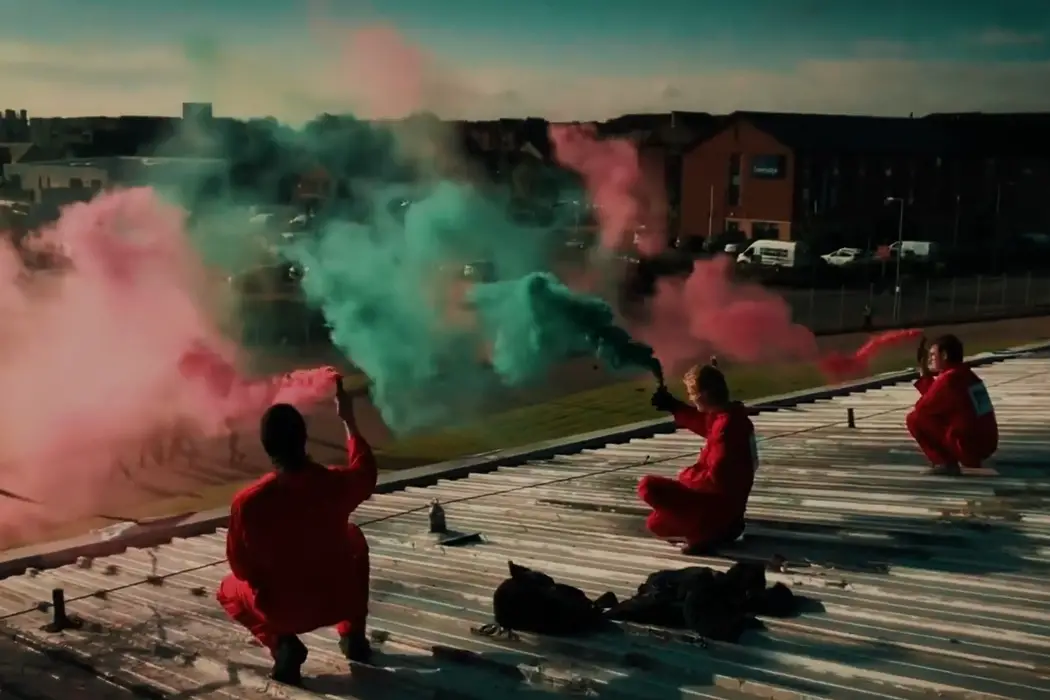

A few days ago, on the morning of April 24, 2026, several activists from People Against Genocide occupied the roof of a UAV Tactical Systems factory in Leicester. They damaged the roof, damaged the drones inside, and otherwise obstructed factory operations, likely causing months of delays in drone production at the site and costing the company hundreds of thousands of pounds. UAV Technical Systems is owned by Elbit Systems, Israel’s biggest weapons manufacturer.
The demonstration bears striking resemblance to a May 2021 direct action led by Palestine Action that saw the group camping for multiple nights on the roof of the same factory. (British health and safety rules dictate that, if you’re on the roof of a factory, no one can be working underneath you.) This demonstration is one of several events depicted in To Kill a War Machine, a 2025 documentary that depicts Palestine Action’s attempts to disrupt the U.K. branch of the Israeli arms industry.
It’s challenging to even write about Palestine Action, since in July 2025, the activist group was labelled a terrorist organization by the U.K. government — i.e. where I live — making it illegal to support the group in the country. It’s also possibly illegal to watch, distribute, or exhibit To Kill a War Machine, given that the documentary is very clearly favorable toward Palestine Action — but info is scant on whether the doc itself has been officially banned by the British government or not. So to reduce the risk that I’ll go to jail over a Substack that probably will only be read by an audience numbering somewhere in the low double-digits, I have to officially say here that, while I think the documentary is well-made and agree with the politics of Palestine Action, I do not publicly support the group. If you want to watch the film, I don’t think I can legally provide you with a link, but you can look at the publicly available resource the Palestine Cinema Archive to see how you can watch it there. Please don’t arrest me.
The U.K. Arms Industry’s Ties to Israel
It’s important to understand how the U.K. arms industry relates to Israel. Arms factories across the U.K., such as the factory in Leicester, are given arms licenses to carry components, blueprints, and so on that can be used by the Israeli military. The country has licensed at least £500 million worth of weapons to Israel since 2015, namely F-35 parts (15% of which come from the U.K.) and surveillance and combat drones.

From 2020 to 2025, Palestine Action has documented and livestreamed its operations to disable the arms trade in the U.K., attempting to block or slow the flow of weapons to the Israeli military. Independent filmmakers known as Rainbow Collective have scoured this collection of footage to assemble a documentary that provides an insightful look at the group’s direct action strategy and its effects.
The Myth of the Objective Documentary
To Kill a War Machine is not only a fascinating documentary about Palestine Action, but the filmmaking itself seeks to demonstrate solidarity with Free Palestine movements in general. It’s a great case study for the myth of the “objective documentary” as well as a riveting demonstration of revolutionary praxis as applied to documentary filmmaking.
Many people assume that documentaries are inherently objective, that they are journalistic in nature, and that most documentaries seek to depict the “unvarnished truth.” While it’s true that some documentaries, yes, are journalistic in scope and style — recent films such as Boys State or Louis Theroux: Inside the Manosphere fit this bill — even those films make decisions about what’s worth documenting, who to speak to, and how to edit those conversations. The filmmaking process is really just a series of decisions that lead to a finished product, and each choice along the way ultimately determines, among other things, a film’s politics.

Most documentary films are progressive in nature, as the form represents an exercise in empathy, awareness, and storytelling that simply aligns more with liberal ideals than conservative ones. (Though there are conservative documentaries, such as the recent Melania film or the work of Dinesh D’Souza.) To Kill a War Machine is on the far left of the political spectrum, and we can tell that’s its political alignment because it features interviews with the activists themselves as well as their friends, families, and allies; depicts uncritically the actions of Palestine Action; and reinforces the group’s anti-genocide, pro-Palestine ideology with its filmmaking choices.
How To Kill a War Machine Reinforces Its Subject’s Ideology
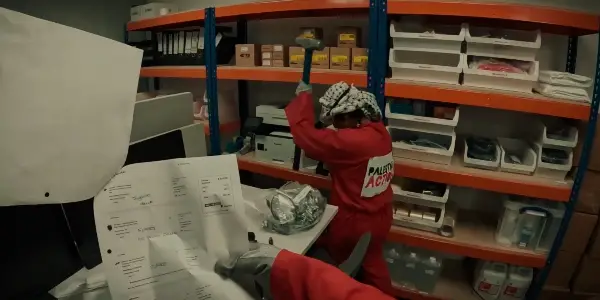
Through its use of first-person archival footage, To Kill a War Machine puts you directly in the shoes of these activists. The filmmakers implicitly ask you to imagine yourself smashing hard drives, stealing top-secret information, sledgehammering windows, and barricading yourself into a drone factory. They ask you to consider how you would behave if you were in their shoes, and whether you have what it takes to stand up for Palestine through direct action.
That ability to force this reckoning onto the viewer helps open their mind to the motivations and goals of Palestine Action and ultimately understand why these acts must be done as well as the ways in which the U.K. is complicit in the slaughter of Palestinians.

“We were sick and tired of begging the powers that be to stop killing our brothers and sisters in Palestine,” the narrator tells us about the origin of their direct action campaign. “I had done the boycott campaigns, I had lobbied politicians, I had organized protests and marches, but nothing was working. Rather than asking any politician to shut weapons factories down, we could go and shut them down ourselves. By putting our bodies on the line and our liberty on the line, occupying these factories, smashing them up, and shutting them down, we could take the power back into our own hands.”
The filmmakers assemble a top-shelf team of diverse voices to explain the motivations of Palestine Action and the strategy behind direct action. This includes Sukaina Rajwani, the mother of a jailed activist; Joe Irving and Sohail Sultan from Palestine Action; Adam Elliott-Cooper from Black Lives Matter U.K.; and Dr. Shahd Hammouri, a lawyer and lecturer at Kent Law School. The use of pro-Palestine voices in these talking head segments puts the viewer in the mindset of these activists just as much as the first-person livestream footage.
What Is “Direct Action”?
For the uninitiated, direct action refers to the use of economic or political power in achieving direct goals. The film invokes the bus boycotts and lunch counter sit-ins of the American Civil Rights Movement as well as the protests and demonstrations of the Soweto uprising in apartheid-era South Africa in 1976.
Palestine Action in particular was inspired by the Raytheon Nine, a group of Derry Anti-War Coalition activists who, during the Israeli war on Lebanon, realized they had a local Raytheon factory in Derry. They went inside and shut it down by occupying the building, destroying documents, smashing the server, and throwing computers out of windows. They used the court case to turn the tables on Raytheon, which ultimately resulted in the company leaving Derry.
Like the Raytheon Nine, Palestine Action seeks to use direct action to make associations with Elbit Systems prohibitively expensive and therefore unattractive for businesses and governments. Sometimes that means smashing the windows and ATMs of Barclay’s locations, which likely led to Barclay’s divesting from Elbit in October 2024. Sometimes that means breaking into Grid Defense Systems in Buckinghamshire, which supplies hard drives and LCD screens to arms companies Elbit and Leonardo, and spray-painting graffiti on the walls, smashing windows with sledgehammers, and breaking hard drives.
This is the kind of direct action that really only works somewhere like the U.K., where the police do not operate with a kind of executioner’s reckless impunity and the defendants can expect that during a trial, the government will not bring the full force of the law down on them and will instead allow them to earnestly plead their cases against genocide to juries of their peers. The U.K. legal system is far from perfect, but the British police in the film almost unilaterally politely and calmly extricate the protesters from the situations whereas it isn’t hard to imagine American police outright killing them on-site.
Throughout, the subjects reinforce that Palestine Action is an organization about hope for the peaceful future of Palestine rather than hate for the murderous colonizers of Israel. But To Kill a War Machine is also a film for adults — it provides a roadmap for how to stand up to Palestine without resorting to squeaky-clean morals or easy silver-lining hope speeches. This is real, the documentary emphasizes. This is happening. The U.K. government funds millions of dollars worth of weapons that go to Israel for the explicit purpose of killing Palestinians.
The Unfathomable Evil of Arms Companies
There are several chilling scenes in To Kill a War Machine that make it essential viewing for any pro-Palestine activist. In one scene, a Gazan surgeon, Nizam Mamode, testifies that every single day, drones would follow up a bomb strike by methodically flying down and shooting the survivors, including children and pregnant women. Shortly after, we learn that Israeli-operated drones have started playing the sounds of babies, children, and women crying as a means of getting people out of their homes so that they can be more easily killed. It’s utterly diabolical, the kind of evil that’s hard to fathom actually exists.
Fans of RoboCop, Starship Troopers, and other Paul Verhoeven films will also shift in their seats uncomfortably during advertisements for these arms companies, which are embedded every so often in the film itself. These chilling commercials, which are the sorts of clips shown at industry trade events like the Defence and Security Equipment International arms fair in London, depict drones slaughtering generic Middle Eastern villains while a narrator brags about “increasing lethality” while “maximizing human survivability.” And while it might be silly to spend time in a pro-Palestine blog post critiquing literal commercials for Israeli murder drones, the wording of the ad makes it clear that Elbit Systems does not see brown people as human beings. Like… those drones just made a Middle Eastern dude’s face explode. That’s not “maximizing human survivability” unless you just aren’t counting the people killed by the drones. But the filmmakers don’t rely on the over-the-top absurdism of these commercials to highlight the brutality of these arms companies — instead, the documentary cross-cuts these ads with footage of the actual atrocities their technology causes.
It only serves to underline the ethos of Palestine Action — mass protests, letters to representatives, and public boycotts are all important organizing tools, but when the opposition literally does not see Palestinians as human beings and only seeks to use them as a testing ground for the arms industry, direct disruptive action seems like the only logical strategy.
Conclusion
There are branches of Palestine Action everywhere focused on an attrition war against the weakest points of the Israeli military-industrial complex. And while arms companies have lobbied the government for harsher sentences for Palestine Action protesters, resulting in the group being listed as a terrorist organization, the group has been successful in causing damage to Elbit Systems and its business relationships. Palestine Action forced Elbit to close two of its factories and leave two of its offices, in London and Boston, and also forced many towns and companies to terminate their relationships with or divest from Elbit.
To Kill a War Machine is a perfect example of how Palestine cinema extends beyond the borders of the country. The U.K. has given Israel funds, resources, and support, and is therefore complicit in the ongoing genocide in Palestine. Activists working in Leicester, Kent, Bristol, Filton, Shenstone, and Wirral are not merely working in a bubble. They are important players in the ongoing struggle to stop the genocide in Palestine. And the documentary that depicts their activism, To Kill a War Machine, is a perfect example of how art can demonstrate solidarity with Free Palestine movements.
If you’ve made it this far, thanks for reading! I was originally intending to discuss the ethics of The Voice of Hind Rajab this month, but given that there was a People Against Genocide demonstration at the factory depicted in this film, I opted to make a last-minute change to cover that instead. Next month, we’ll take a look at Hind Rajab, one of the most upsetting films of 2025. If you’re reading this column and would like to share your perspectives on the work I cover, or if you’re Palestinian and want to open a dialogue, my email is listed below. This column is also available to read on my Substack, which you can subscribe to here.
Contact me at [email protected]
Does content like this matter to you?
Become a Member and support film journalism. Unlock access to all of Film Inquiry`s great articles. Join a community of like-minded readers who are passionate about cinema - get access to our private members Network, give back to independent filmmakers, and more.