












THE SAVIORS: Paranoia, Perspective, and the Danger of Assumption


Categorization isn’t easy here and that feels exactly as it should be with a movie like this. The Saviors is provocative, blending satire and horror with a splash of sci‑fi. Director Kevin Hamedani crafts a film that’s as infuriating as it is engaging, delivering surprises at nearly every turn.
Within the narrative is an exquisite opportunity for an adventure in tone and concept. Folding itself into shifting shapes, it isn’t until the finale, when the film’s true form locks into place, that clarity finally arrives. It’s an effective and intelligent genre‑bender that keeps you guessing until the very end.
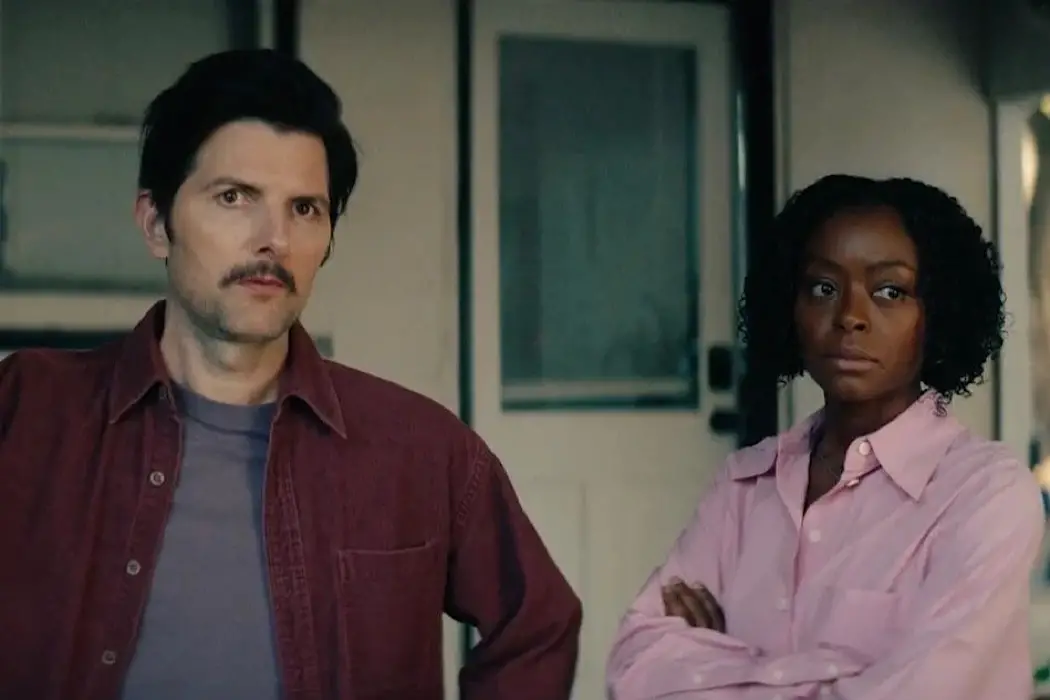
Married couple Sean (Adam Scott) and Kim (Danielle Deadwyler) are on the brink of separation and, hoping to stabilize their finances, decide to rent out their guest house as an Airbnb. Enter Middle Eastern siblings Amir (Theo Rossi) and Jahan Razi (Nazanin Boniadi).
Paranoia
Armed with his own unexamined prejudices, Sean begins to spiral into paranoia about their new guests. Strange lights, uneasy glances, and odd behaviors escalate from mild discomfort into outright assumption. When Kim’s journal goes missing (and she later sees Amir using it to take notes at a bar) she too begins to distrust the siblings. Soon, the couple is watching them day and night, always expecting the worst.
There’s an intriguing suburban dread here, recalling films like The ’Burbs and Arlington Road, yet The Saviors remains entirely its own. While I had some issues with character development and pacing toward the end, I ultimately dug it. The finale takes a deliciously weird turn, though I found myself wishing it landed with a bit more impact. I couldn’t help thinking of T.S. Eliot’s line: “This is the way the world ends. Not with a bang but a whimper.” And yet—I wanted a little more of a bang. I wanted to feel the finality, not just see it.
That being said I really did love the film and cast is magnetic; keeping me glued to the screen. Even with its quirks, I wanted more. There are multiple paths through The Saviors. On one level, it’s a psychological study of paranoia, racial profiling, and stereotypes. On another, it’s a tense examination of instinctual judgment and unease. The film continuously twists perception, flipping the ground beneath you while sustaining an irresistible sense of curiosity.
Perspective
What makes The Saviors especially compelling is how often it flips the narrative. What you think you know, you don’t—and depending on perspective (a key part of the film’s thesis), who the “bad guy” is keeps changing. The script is sharp and filled with intriguing plot devices, culminating in an ending that lands like a mic drop. Wanting more isn’t a flaw; you want those questions to linger, especially after such a loaded conclusion.
Dry humor runs throughout deeply uncomfortable situations, aided greatly by Adam Scott’s performance (who lets face it, is always amazing). Danielle Deadwyler keeps pace with him, though at times I wished her character had more room to shine. I think we are given more context when it comes to Sean as we are also introduced to his family (who casually flaunts their right‑wing behavior) providing sharp insight into his worldview, particularly in scenes with his sister Cleo (Kate Berlant).
Eventually, the story introduces private investigator Jim Clemente (Greg Kinnear), whose over‑the‑top presence occasionally feels disjointed, briefly disrupting the film’s otherwise tight tonal balance. Still, Kinnear seems to be having fun with it, so I did too.
The Saviors remains dramatic and quietly powerful, with Theo Rossi and Nazanin Boniadi emerging as standout performers.
Conclusion:
You may not always like the characters, but The Saviors ensures you’re invested enough to see the journey through; and to question your own assumptions along the way. Hamedani has created something that is uniquely discomforting. It’s the kind of bold storytelling we need more of.
Does content like this matter to you?
Become a Member and support film journalism. Unlock access to all of Film Inquiry`s great articles. Join a community of like-minded readers who are passionate about cinema - get access to our private members Network, give back to independent filmmakers, and more.